


Most of the “Top social media monitoring tools” articles focus on the same list of solutions, describing their pros and cons again and again, until the reader loses interest. What if we tell you that there’s more to this “top”? In 2026, the market is so full of options that ignoring its depth and width is almost a sin for someone wanting to find the best fit.
That’s why we offer a bit of a different approach here. Here’s what you'll find in this guide:
- Signal AI connects dots across global media and catches narrative shifts early, though you'll need an enterprise budget and patience for the sales process.
- Truescope keeps PR teams sane during busy campaign cycles.
- Sonar tracks conversations across social, news, and commerce in real time, with crisis detection that warns you before things spiral.
- Agorapulse brings order to agency chaos with an inbox that actually makes sense and team workflows that don't need constant explaining.
- Neticle reads sentiment in European languages the way global tools can't, which matters if you're working in markets where context gets lost in translation.
- Walls.io gets social walls up fast for events and websites, with clean visuals and easy moderation.
Who will find this especially helpful? If you’re tired of seeing the same names over and over again, you’re welcome.
Top Social Media Monitoring Tools
AI's flooding feeds with content, real conversations move so fast they're practically over before they start, and brands are constantly managing tiny fires that could become big ones. Welcome in 2026.
What separates the tools that work from the ones that waste your time?
- They show you what's happening now, not twenty minutes ago.
- They catch the typos, the creative misspellings, and hashtag variations.
- They connect to your existing workflow without turning integration into a three-week project.
- They recognize sarcasm and don't send panic alerts every time someone tweets "oh great, another update."
- And they automate the boring parts so you can focus on the decisions that actually need a human.
If a tool checks these boxes, it's worth considering.
What Are Social Media Monitoring Tools?
Social media monitoring tools track what people publicly say about a brand, product, or topic across different platforms. They collect mentions, comments, tags, and keywords so you don’t have to manually watch every channel.
Monitoring vs. listening
- Monitoring gathers the what – raw mentions and activity.
- Listening explains the why – patterns, mood, and meaning behind that activity.
Who needs this?
- Brands: reputation tracking and campaign feedback.
- Agencies: managing multiple clients without chaos.
- Creators: spotting trends early and understanding audience reactions.
How AI changed things (2020 → 2026)
The AI leap between 2020 and 2026 is wild:
- Sentiment detection actually works now.
- Anomaly alerts pop up when something genuinely unusual is happening.
- Context matters again, so you're not getting alerts about "apple" when people are discussing fruit.
- Conversations get grouped intelligently, and pattern recognition stretches across text, photos, and short video content without needing separate tools for each.
We've moved from "let's collect everything and sort it out later" to "here's what's happening and here's why you should care," which is a much better place to be.
Delivering the Raw Data for Your Social Media Listening Tools
If your listening setup feels shaky, nine times out of ten the problem starts at the data layer. Fancy dashboards won’t save you if the input is late, patchy, or oddly filtered. Social media APIs exist to solve exactly this – and Data365 does it without making your life harder than it needs to be.
At a basic level, APIs deliver raw public data: posts, mentions, profiles, engagement numbers, all neatly packed in JSON. No opinions, no summaries. Just the raw material your listening logic needs to work with.
Where Data365 actually helps
Anyone who’s dealt with native platform APIs knows the drill: rate limits hit, endpoints change, something breaks when your team is already stretched thin. Data365 steps in between you and the platforms, so you can focus on what comes next.
With Data365, the flow looks like this:
- You send a clear request – a profile, keyword, or hashtag.
- You get structured JSON with timestamps, text, metadata, and engagement stats.
- You feed the data straight into your listening logic or AI models.
This setup gives teams breathing room:
- Developers spend less time fixing integrations and more time building.
- Analysts work with consistent data instead of wondering what’s missing.
- Product teams can trust trends and alerts because the input is stable.
If you’re ready to try and upgrade the data you use for monitoring and analysing, contact us, and we will do the rest.
Enterprise Social Media Monitoring Tools
Signal AI

Best for:
- Signal AI is built for teams that can’t afford to miss a story or a risk signal, e.g., sensitive topics or industries.
- It’s most useful for large enterprises and agencies handling high-stakes PR, communications, or risk management.
- If your work involves tracking reputation, monitoring regulatory changes, or understanding how narratives evolve across global media, this is the kind of tool that lets you see connections before they become problems.
- Mid-sized agencies handling multiple clients with sensitive campaigns can also make good use of it, particularly for real-time alerts and AI-generated summaries that save time and reduce blind spots. For small teams or low-volume monitoring, the platform’s depth and setup may feel heavier than necessary.
Pros:
- AI analysis that is strong at entity relationships, narrative shifts, and trend forecasting.
- Built for high-stakes monitoring. Handles large volumes, global coverage, and continuous tracking well.
- Actionable alerts and reports. Designed for exec briefings, not just analyst dashboards.
- Enterprise-ready integrations. Fits into existing data and reporting ecosystems.
Cons:
- The platform is designed with scale in mind. For smaller teams or simpler monitoring needs, some features may feel more than strictly necessary at first.
Truescope

Best for:
- Truescope works best for teams that deal with public narratives for a living.
- PR and communications teams use it to stay on top of reputation, crisis signals, and media coverage without constantly refreshing feeds.
- Mid-sized agencies like it for client monitoring and reporting, especially when several campaigns are running at once.
- Enterprises and public-sector teams benefit most, thanks to collaboration features, API access, and the ability to handle high volumes without slowing down.
- Small agencies can still get value – the UI is approachable, and alerts are fast – but the real payoff shows up once multiple stakeholders and workflows are involved.
Pros:
- Alerts show up when they should. Spikes in mentions and sentiment changes don’t lag, which makes it usable for real crisis work, not just reporting after the fact.
- You can set up dashboards and queries without turning it into a mini project or pulling in technical help.
- Support is hands-on and practical. You get help with real use cases – refining queries, structuring reports, fixing blind spots, not canned answers.
- Handles multiple campaigns, clients, and collaborators without performance issues.
Cons:
- Advanced features need setup time.
- Coverage is strongest in Asia-Pacific.
Social Media Monitoring Tools for Agencies
Sonar

Note: "Sonar" is a name used by completely unrelated products in the tech space, so looking for tutorials and other users’ experiences might be a complicated task of filtering.
Best for:
- It’s a solid fit for mid-sized companies and regional agencies that need reliable local monitoring.
- PR teams dealing with fast-moving public sentiment, marketers tracking campaign reactions, and brands working with local influencers tend to get the most value out of it.
- Smaller agencies often use Sonar to keep an eye on markets and spot early warning signs without enterprise-level complexity.
- Larger regional teams use it to line up social, media, and brand performance data in one place, especially when campaigns need close, real-time attention.
Pros:
- It sweeps across social platforms, news outlets, and even commerce channels in real time, which gives you a fuller picture when you're trying to understand how a story or brand conversation is actually moving through different spaces.
- The sentiment analysis goes beyond basic positive-negative sorting, and the topic clustering helps you spot patterns before they become obvious.
- The crisis detection feature is particularly useful if you need early warning signals rather than finding out about a problem when it's already trending.
- Dashboards can be configured to surface what actually matters for your team, and the reporting structure is built with decision-making in mind.
Cons:
- Sonar's coverage is the strongest in certain regions (Indonesia).
Agorapulse

Best for:
- Agorapulse works best for small to mid-sized agencies and in-house teams that manage multiple accounts and need structure more than scale (agencies with 5 to 50 people tend to get the most value).
- For growing teams, it hits a comfortable middle ground: powerful enough to look professional, simple enough that new team members don’t need weeks of onboarding.
- Larger enterprises can use it, but if your priority is high-volume global monitoring or deep media analysis, Agorapulse may feel more operational than strategic.
Pros:
- Inbox-driven workflow that actually works. Mentions, messages, and comments stay organized, which makes day-to-day management far less chaotic.
- Collaboration feels natural. Clear roles, approvals, and account separation keep teams aligned without micromanagement.
- Monitoring without enterprise bloat. Listening features are strong enough for most agency needs without pushing users into higher-tier platforms.
Cons:
- Instagram tooling has limits.
Social Media Brand Monitoring Tool
Neticle

Best for:
- Neticle is at its best when language and local context aren’t optional extras.
- If your monitoring work involves European markets, especially Central and Eastern Europe, this is where it earns its keep.
- PR teams dealing with reputation risk, communications leads tracking public opinion, and marketers trying to make sense of product feedback in languages like Hungarian or Polish tend to trust Neticle more than broader global tools.
- Mid-sized agencies appreciate that they can bring the whole team in without counting seats, while larger organizations use it as a backbone for serious monitoring – feeding real-time data into BI dashboards and keeping a close watch on sentiment shifts that would otherwise slip through the cracks.
- Smaller teams can start with lighter setups, but Neticle really pays off once monitoring becomes a core part of decision-making, not just a nice-to-have.
Pros:
- High-quality sentiment and emotion detection in local languages. Especially strong where global tools often misread context.
- APIs built for real use. Real-time feeds slot cleanly into custom dashboards or BI setups.
- Pricing that scales with needs, not headcount. Unlimited users make collaboration straightforward.
- Depth beyond basic metrics. Topics, emotions, and attribution add real analytical value.
Cons:
- Best suited for Europe; less coverage depth elsewhere.
- Setup may not be that instant.
Walls.io

This is fundamentally a display tool, not a listening command center. If you need to track conversations over time or measure brand health, you'll still need something else in your stack. However, the tool still offers many interesting features that might support your social media monitoring processes.
Best for:
- Walls.io works best for teams that need quick, visually appealing social displays.
- Agencies and small to mid-sized teams running hybrid events, product launches, conferences, or client websites can set up live walls (that curate and display real-time posts, photos, and videos from different social media networks) in minutes.
- It’s especially effective for agencies or event planners who need agility, fast results, and a clean presentation.
Pros:
- Walls.io pulls data from various social platforms and accepts direct submissions, which means you're not stuck fishing in just one or two pools when you want to capture what people are saying across channels.
- You can filter content quickly, tweak the visual presentation without needing a developer on speed dial, and drop the wall into WordPress or other platforms without wrestling with code.
- They've built in GDPR and CCPA compliance from the ground up, and there's a clear focus on hybrid events.
Cons:
- It shows you what's being said, but doesn't dig into why or how attitudes are shifting.
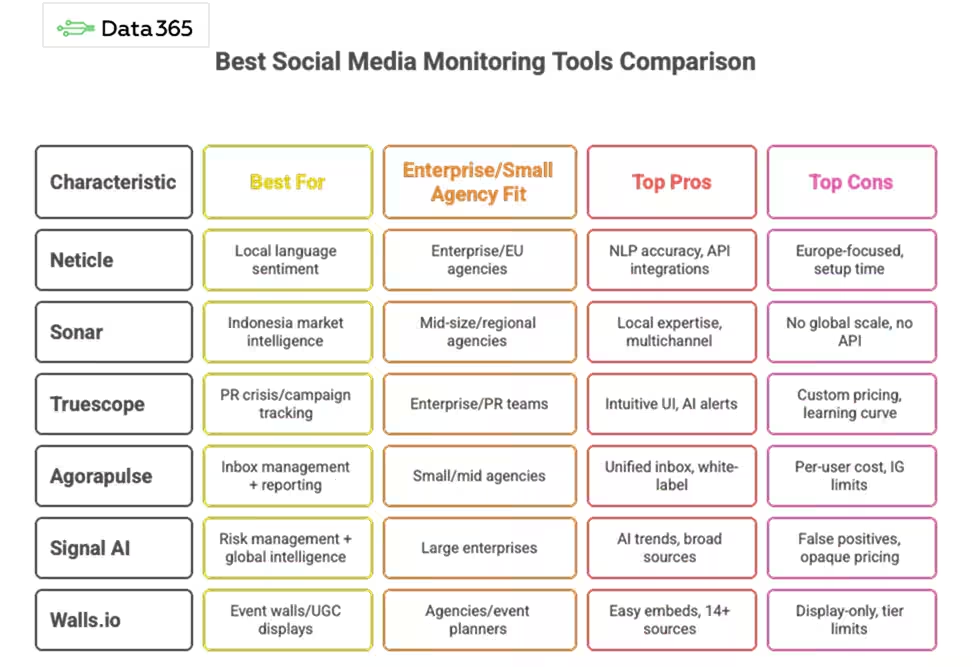
Social Media Monitoring Tools Comparison
Conclusion
The best monitoring tool is the one that fits how you actually work. If you're managing crisis communications for a multinational, you need different things than someone tracking campaign feedback for three clients in the same city. There's no universal winner here, just better and worse matches for what you're trying to do.
But here's the part that gets overlooked: even the smartest platform falls apart if the data feeding into it is inconsistent, delayed, or incomplete. You can't analyze what you're not capturing properly. Sentiment analysis means nothing if crisis detection doesn't work when alerts show up late because an API decided to take a break. That’s why where you get your raw data is important.
If you want to build your own monitoring tools, Data365 is a great foundation. It handles the unglamorous work of pulling clean, structured data from social platforms so your monitoring setup has something reliable to work with. No rate limit surprises, no random gaps, no wondering why yesterday's numbers look off. The tools do their job better when the foundation isn't constantly shifting underneath them. Start there, and the rest gets considerably easier.
Extract data from top social media networks with Data365 API
Request a free 14-day trial and get 20+ data types






.svg)
.svg)
.svg)


.svg)
.svg)
.svg)
