


TikTok doesn’t lack data. It’s businesses that lack access.
The platform produces more cultural signals in a single day than most platforms do in a month.
Trends appear, peak, mutate, and disappear before a weekly report is even drafted. And most businesses see… nothing. They scroll. They guess. They screenshot trends after they’ve already passed. Track hashtags, sounds, and engagement growth before they peak.
TikTok shows you what it thinks you want to see, not what you need to analyze. This is where TikTok data collection enters the picture, not as a growth hack, but as a data access layer.
Overview:
- DIY browser scraping – simulates scrolling and parsing pages, but breaks often and needs constant fixing.
- Reverse-engineered APIs (Python) – pulls structured data from internal endpoints, faster but unstable and tend to break silently.
- Third-party APIs (Data365 Social Media API) – outsource collection and get consistent, ready-to-use data without maintaining the scripting layer.
Ready to do it in a faster, more efficient way? Let’s collect some TikTok data and find patterns that lead somewhere useful.
Use TikTok Scraper (Or Other Tool) to Get Data that Matters
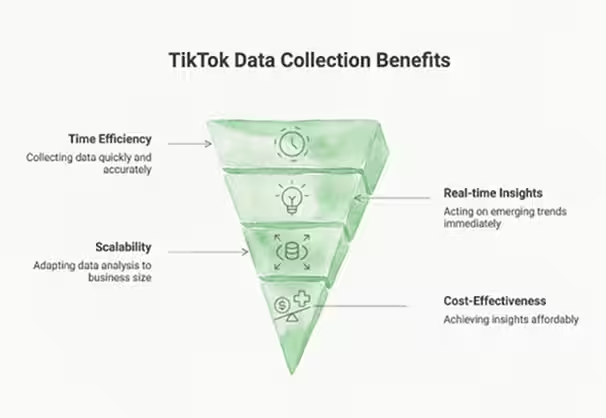
TikTok can give you thousands of fields per video. Collecting all of them feels productive, but usually it isn’t, at least not without a clear goal. Raw numbers without context create false confidence:
- High views, but no engagement.
- Viral videos, but zero conversion impact.
- Creators who spike once and disappear into the platform’s void.
The point isn’t that TikTok data lacks value. In fact, there are dozens of useful signals – from engagement metrics to comments, sounds, and posting patterns – and platforms like Data365 make it possible to collect them consistently.
What matters is how you approach them.
Before collecting data, it helps to ask a simple question: what decision will this support?
The same metric can either be noise or a missing piece of the puzzle, depending on the goal.
Useful TikTok data answers specific questions. Everything else may look impressive, but only becomes valuable when it fits into a strategy.
The Core TikTok Data Categories That Matter
1. Engagement Dynamics (Not Just Totals)
Most people look at views, likes, and comments. However, these numbers don’t really sit still.
The same view count can mean very different things depending on how it got there. Some videos climb fast and burn out. Others move slowly and keep going. On the surface, they may look similar, but in motion, they tell different stories.
That’s where details like engagement velocity, ratios, or time to peak start to matter. Not as rules, but as ways to notice how content behaves.
A video that reaches 50k views in a couple of hours feels different from one that takes a month to get there. Not better or worse, just a different kind of signal.
When this kind of data is collected over time, those differences stop being intuitive guesses and start becoming visible patterns, the kind TikTok itself doesn’t really show.
2. Hashtag and Sound Trajectories
Hashtags and sounds are TikTok’s bloodstream. The valuable insight isn’t: “This hashtag has 1B views.” It’s:
- How fast is it growing?
- Who is using it early?
- How long does it stay relevant?
- What types of content does it attach to?
Collected data lets you see momentum, not just popularity. That’s how TikTok trends are spotted before they feel obvious and everyone is using them.
3. Creator Behavior Patterns
Follower count is a weak signal on its own. More useful questions would be:
- How often does this creator post?
- Do they repeat formats?
- How consistent is engagement?
- Do viral spikes correlate with specific hooks or sounds?
Retrieving these data over time reveals patterns that aren’t visible on a single profile visit. This is how brands find reliable creators, not just loud ones.
4. Comment Data (The Most Underrated Asset)
Comments are where TikTok stops being performative and starts being honest. Сomments can show:
- Sentiment toward products or features.
- Repeated questions or objections.
- Slang and phrasing audiences actually use.
- Early signs of backlash or fatigue.
For product teams and marketers, this is qualitative research at scale.
5. Timing & Format Signals
TikTok success isn’t random. It’s patterned. Collected data can reveal:
- Optimal posting windows.
- Video length ranges that perform best.
- Caption structure trends.
This can turn content decisions from guesswork into informed choices.
A Simple Rule for Data Value
Efficient data collection isn’t about “my data is bigger than yours.” It’s about intentional collection. Once you know what data matters, the next question becomes unavoidable: How do businesses actually collect this data – reliably and at scale? That’s where tools, infrastructure, and trade-offs come in.
If intention, planning, and scaling are what you’re trying to achieve, Data365 is here to support these goals. Let us know what data and how much of it you’re planning to collect, and start your 14-day free trial immediately!
The Three Practical Ways Businesses Collect TikTok Data
Most TikTok data retrieving setups fall into one of three categories. Each comes with trade-offs because there is no free lunch.
1. TikTok Scraper Online (DIY, Fragile, Educational)
This is where many teams start. It is like manually copying data with very fast hands. It works, until it doesn’t.
Typically involves:
- Headless browsers.
- Simulated scrolling.
- HTML parsing.
- Frequent breakage when TikTok changes layouts.
Pros:
- Full control.
- Low upfront cost.
- Good for learning and small experiments.
Cons:
- Breaks often.
- Hard to scale.
- Slow.
- Maintenance becomes a full-time job for some unlucky champion on your team.
2. Python TikTok Scraper: Fast, Fragile, and Easy to Misread
Some TikTok scrapers don’t parse pages at all. They talk directly to the same internal endpoints the TikTok app uses.
These endpoints are undocumented, change without notice, and are protected by aggressive rate limits and fingerprinting. What works today may silently degrade tomorrow, or return partial data without raising errors.
These APIs are powerful and risky. They reduce complexity at the surface level while increasing it underneath.
Pros
- Faster.
- Cleaner data.
- Easier analysis.
Cons
- Endpoints change.
- Access can be throttled or blocked.
- Requires constant monitoring. (Yes, it seems like that one person on your team simply can’t avoid their destiny no matter what you choose.)
3. TikTok Scraping vs APIs (Stable, Abstracted)

Many businesses eventually reach this point. Often with some scratches and bruises. You give up ownership, but instead you get reliability. Quite a deal for non-engineering teams. These solutions:
- Send requests to an API.
- Receive clean, normalized data.
- Avoid handling proxies, fingerprints, or failures.
By the way, here’s a description of a solution that works that way – Data365.
Pros
- Predictable.
- Scalable.
- Minimal engineering effort.
- Minimal intervention from your side. (We finally managed to save that person).
Cons
- Cost.
- Less low-level control.
- Dependency on a provider.
Choosing an Approach (A Simple Framework)
Ask yourself:
- How often do we need this data?
- How much breakage can we tolerate?
- Who maintains the pipeline?
- Is this core infrastructure or supporting research?
If insights from the gathered data supports decision-making, stability matters more than cleverness.
When a TikTok Scraper Isn’t Enough: APIs Like Data365 Work Better

After a few scraping experiments, most teams run into the same thought: Why are we spending time maintaining this instead of using the data?
Because at some point, scraping stops being interesting and starts being… maintenance. Things break, data goes missing, something changes on TikTok’s side, and suddenly you’re fixing pipelines instead of analyzing anything.
That’s usually the moment APIs enter the picture.
Instead of handling all of that yourself, you pass the collection part to Data365, and just get the data back in a format you can actually work with.
In practice, it means:
- You receive structured JSON data for things like posts, profiles, hashtags, engagement, а or any other data type out of 20+ available.
- The data format stays consistent over time, even when platforms change something on their side.
- The same structure can be used across multiple social platforms, so comparison doesn’t turn into a cleanup project.
- Data arrives on demand, not from some outdated cache, so you’re not analyzing yesterday’s version of TikTok.
- Historical data access, so you’re not stuck analyzing a single moment but can see how things evolve.
- The system handles large volumes and frequent requests, without you rebuilding anything.
- Predictable credit-based pricing lets you scale usage without guessing what the next bill will look like.
Nothing magical. Just fewer moving parts to worry about.
How Data365 Is Used
Data365 is typically used when:
- Teams need public TikTok data every day, not every now and then.
- Consistency is way more valuable than experimental flexibility.
- Data retrieval supports a lot of branches and tasks, like reporting, analytics, or dashboards.
- You don’t want to waste your engineering resources on something that can be managed by software.
Instead of maintaining custom scrapers, teams query TikTok data the same way they’d query any other external data source. This doesn’t make data collection “easier,” it makes it predictable.
They’re usually overkill when:
- You have no idea what to do with really large amounts of data.
- You believe there’s no way to know everything that goes on on TikTok and are fine with this.
- If you just want to take a quick look at some posts and have no intention to collect data.
- If you don’t plan to scale in the near future.
- If your analytics are not 24/7.
So, if you can recognize yourself in this second list, don’t contact us. However, if you plan and dream big in terms of TikTok data collection (or other popular social media platforms, too), get on board. We’re going on data gathering.
What Happens After Data365 API Finishes Its Part: From Raw TikTok Data to Business Insight
Collecting TikTok data already feels like progress, but actual progress starts after that.
Raw TikTok data is inconsistent by nature. Metrics update unevenly, videos disappear, comments shift tone over time, and regional behavior skews numbers in subtle ways. If this data is consumed as-is, it doesn’t just confuse, it misleads.
- The first real step after collecting is making the data comparable. That means aligning timestamps, stabilizing metric definitions, and accepting that TikTok numbers are snapshots, not facts carved in stone. Without this step, trend analysis turns into pattern-matching fiction.
- Once data is stable, time becomes the most important dimension. A video’s performance only makes sense in motion. Early acceleration, peak velocity, and decay matter far more than absolute totals. This is where TikTok stops being a popularity contest and starts behaving like a signal system.
- From there, context is added. Comments are grouped by sentiment, captions by language, and creators by behavior rather than follower count. On their own, these layers are noisy. Together, they explain why something worked, not just that it did.
- Finally, the data has to be accessible. Not perfect. Not elegant. Just reachable by the people who need it when decisions are made. If TikTok insight lives in one analyst’s notebook, it dies there.
The teams that get value from TikTok data don’t obsess over dashboards. They build quiet systems that watch consistently, compare historically, and inform action without demanding attention.
Data collection opens the door. Workflows decide whether anything useful walks through it. Of course, you still have to deal with everything that comes after. But at least one part of the process can behave. Platforms like Data365 already take care of collecting and structuring the data, so you don’t have to babysit scripts or wonder why today’s dataset looks… suspiciously empty.
If you’d rather spend your time figuring out what the data means – not whether it arrived at all – you know where to find us.
Conclusion: From Scroll to Signal
Most people experience TikTok the same way: endless scrolling, occasional surprises, and the feeling that something important is happening somewhere in the feed.
Businesses can’t operate on that feeling. They don’t need fast dopamine, they need to become a source of that dopamine for their audience.
Data collection doesn’t magically reveal the next viral trend. What it does is turn TikTok from a stream of impressions into something that can actually be observed and compared. Once the data is structured, patterns start appearing where there used to be noise.
In the end, TikTok doesn’t really lack data. It lacks patience. Patterns take time to show up. And while you’re busy figuring out what actually matters, it helps if at least the data collection part runs quietly in the background instead of asking for attention every other day.
That’s where tools like Data365 come in. They take care of the messy maintenance part and hand you structured data that’s actually ready to work with. Which means you can spend less time fixing things and more time finally understanding what all that TikTok noise was trying to tell you.
Extract data from top social media networks with Data365 API
Request a free 14-day trial and get 20+ data types




.svg)
.svg)
.svg)


.svg)
.svg)
.svg)
