


Somewhere on X right now, someone has just published their opinion about what you're interested in: a product defect, a competitor's launch, or a reaction to the latest news. A large amount of that conversation is publicly accessible – but accessing it at scale is another question.
The catch is the grabbing. X's Enterprise plan is the most complete way to do it:
- It offers the whole stream.
- It gives access to the full archive of posts.
- And you finally have a dedicated team on the other end in case something goes wrong.
- And the Twitter API Enterprise’s price mirrors all of these advanced capabilities.
That's why, before you sign, you should know exactly what you'd be paying for, what it takes to run, who actually gets their money's worth, and which alternatives could get you the same value for a fraction of the cost.
Let's go through it.
What is X (Twitter) API Enterprise?
Enterprise is the top shelf of X's data access. It isn't a separate API. It's the same API with the lid taken off: everything in the standard X API, plus high-volume endpoints, custom rate limits, and a named account manager.
The difference starts with how you buy it. Standard access is self-serve and metered. Enterprise is negotiated: you apply, and X builds a package around your data volume, the endpoints you need, and the level of support. X's documentation also mentions longer-term contracts.
What's inside of X API Enterprise?
Instead of memorizing endpoint names, think of the plan as four jobs it does for you:
Around the endpoints sits the service layer: custom rate limits, your own account manager, and priority issue resolution.
X's documentation currently describes Enterprise in two layers: the newer v2-style products (volume streams, likes streams, Powerstream) and the older Gnip-era ones (PowerTrack, Decahose, Historical PowerTrack). Which of them end up in your package depends on what X provisions for you, so ask sales for the exact list.
Enterprise isn't a better version of the standard API. It's a different answer to a different problem. If your problem sounds like one of the four below, it's worth the conversation with X's sales team.
X (Twitter) API Enterprise: Who Should Choose It (and Who Shouldn't)
- You can't afford to miss a post.
Sampling is fine for trend charts. It isn't fine for brand-safety monitoring, crisis response, financial signals, or any product where a single missed post is a missed alert. This is Enterprise's main argument: X's documentation describes the full firehose as every public post in real time, with no sampling and no gaps.

- You need depth, not just recent history.
Standard access starts with recent posts, and deeper archive search typically requires an access upgrade. Enterprise includes full-archive search, plus batch filtering over the archive. That's the difference between "what are people saying this week" and "how has the conversation about us changed over five years".
- You've outgrown pay-per-use.
Standard pricing is metered and has a monthly cap on post reads. Past the cap, X's own guidance points to an Enterprise arrangement. If you already spend heavily on reads, or you're doing the math and the bill is approaching that ceiling, you're the person this plan was built for.
- Your customers depend on your data feed.
If you resell or build on X data, an outage is your problem. Enterprise adds the service layer that a product business needs: custom rate limits, a named account manager, priority issue resolution and a real-time compliance feed so your stored data stays current when users delete or edit posts.
What you give up in exchange
Every advantage above has a cost on the other side of the ledger:
- Money, with no price tag. Enterprise pricing is negotiated, based on data volume, endpoint usage, and support requirements. From the X’s own documentation, we know that $42,000 a month is a starting point.
- Engineering time. A firehose isn't an API key. Someone has to build, host, and monitor the infrastructure that consumes it, and someone has to maintain the process that keeps your stored data in line with deletions and edits.
- A commitment. X's documentation mentions longer-term contracts. That's fine when your needs are stable and uncomfortable when they aren't.
- Platform risk. In 2026, X replaced its whole pricing structure in a matter of months. Whatever you sign, plan for terms to change.
A quick test
If the right-hand column sounds like you, you're not behind. You're simply the target of this chapter.
Twitter Enterprise API Pricing: The Number X Won't Print
In February 2026, X shifted to pay-as-you-go pricing for everyone except those on the Enterprise plan. Their needs were acknowledged as something that needs a tailored approach. Probably, that’s why X doesn't publish a rate card for Enterprise.
Though it does something almost as revealing: it asks you to name your budget. The application form has a Monthly Budget field, and the options run from $42,000 to $210,000.
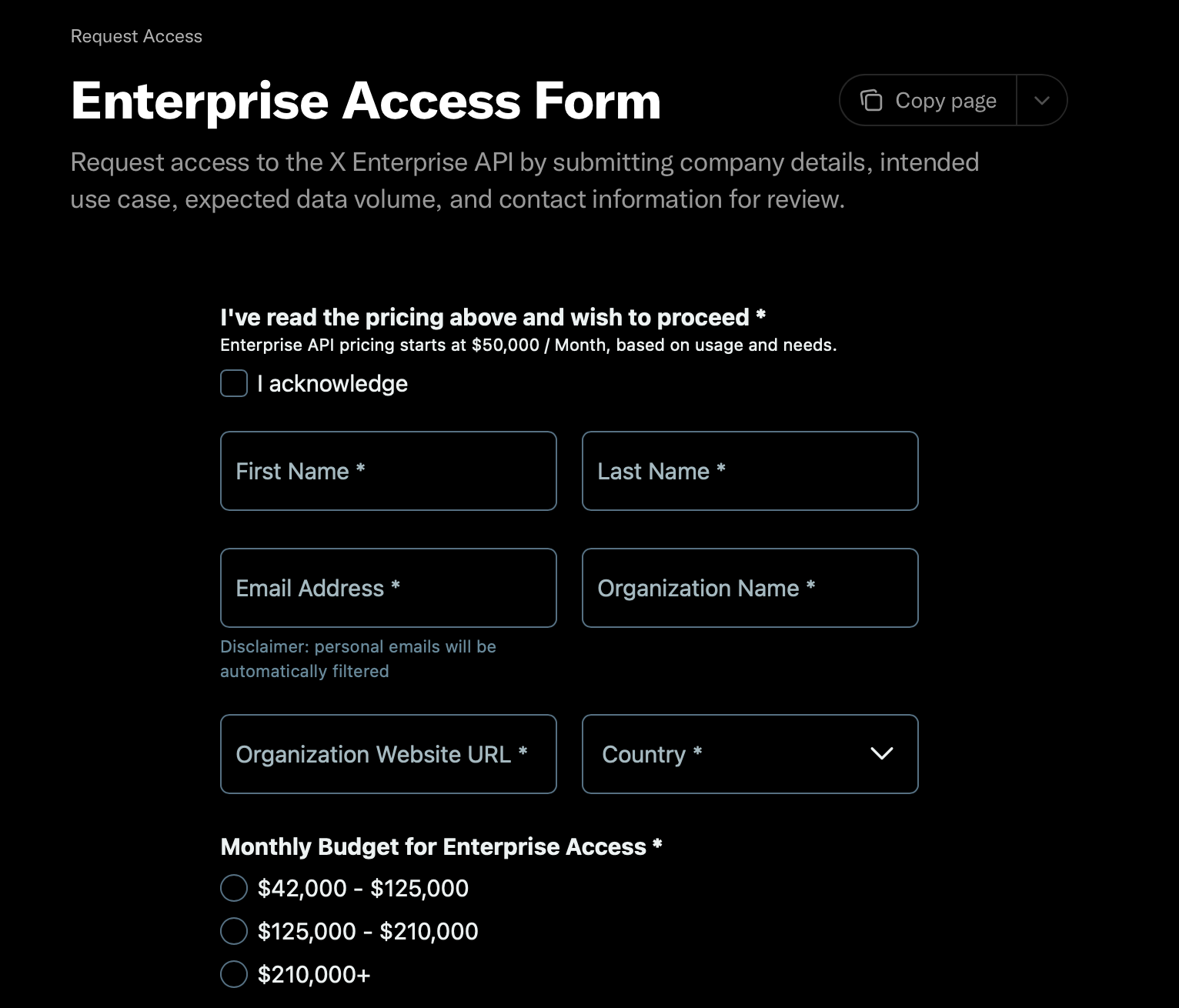
That's the closest thing to an official price tag you'll get, and it's exactly that: a ballpark, nothing more. What you'll actually pay depends on what you actually need: your data volume, the endpoints you use, your throughput requirements, and your support level.

Third-party API: An Easier Alternative to the Enterprise API Twitter
What to do if you need that data, but the Enterprise plan doesn’t feel right for your use case and for your budget? Look elsewhere. With third-party X API’s, you don't negotiate with X, and you don't commit to a package sized for someone else's appetite. You send a request, and you get data back.
Whether that's a clever shortcut or a compromise depends on what you need. Let's start with the case for it.
What "easier" means
Easier to buy. The Enterprise route runs through an application form, a budget bracket, a custom quote and a longer-term contract. A provider like Data365 starts with a short form, followed by an API key, documentation, and a ready-made Postman collection for a free 14-day trial. You can test it against your real use case before anyone asks for a signature.
Easier to run. Data365's flow is three calls: one to launch a collection, one to check its status, and one to retrieve the result as clean, structured JSON. There's no stream to keep alive and no infrastructure to supervise. Data365 also has 99.9% uptime and a team that watches for changes in platform behavior, so a pipeline doesn't break when X moves something.
Easier to pay for. Enterprise charges for capacity: you buy the package, then hope to fill it. Data365 works on credits, with usage statistics you can check as you go, so the bill follows what you collect.
Easier to outgrow X. Nobody monitors one network forever. A public-data workflow on X may later expand to supported public data from Instagram or TikTok. Data365 provides a unified structure across supported networks, while available data types and retrieval options vary by platform.
What you get
For X, Data365 retrieves publicly accessible information such as public profiles, posts, and engagement metrics available without authentication.
Data is pulled live at the moment of your request, not served from a cached dataset, and Data365 can retrieve publicly accessible posts available through supported public profile feeds. You decide what to collect and how often it refreshes, and scheduled auto-update tasks handle the repeat work.
The data arrives unprocessed, exactly as it appears on the platform, which suits teams that want to run their own analysis.
Data365 offers a free 14-day trial with 20+ data types across 8 social media platforms. Contact us if you want to try.
Social Media Listening Use Case: How to Predict the Unpredictable
Social media listening is a constant pursuit. An election night, a tournament final, a major release: every one of these events has the same pattern. The volume spikes, opinion forms in real time, and then it's over.
Why it might feel like the X API Enterprise job
Big events produce big numbers, and in the moment, completeness feels non-negotiable. What if the post that matters, the one that becomes the headline, is the one you didn't capture? Enterprise's promise of every public post, with no sampling and no gaps, sounds like the only safe answer.
Why the contract doesn't fit the calendar
The trouble starts before the first post arrives.
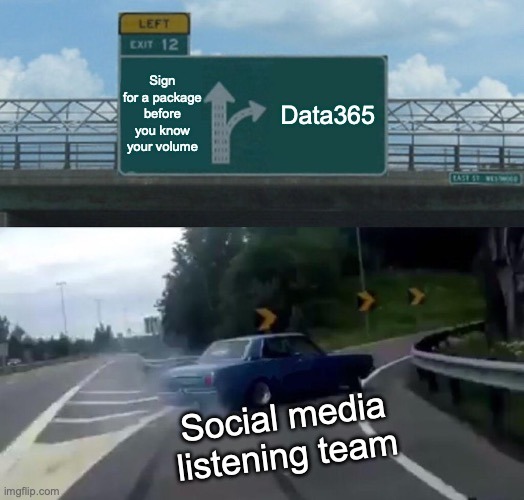
You commit before you know your volume. Enterprise is a negotiated package: you choose a budget bracket, describe your needs, and X sizes a quote around your data volume. For something as impossible to predict as social media events are, that means forecasting traffic you can't forecast. Is election night a normal day, or ten times a normal day? You won't know until it happens, and by then the contract is already written.
The route in has several steps. There's an application form, a budget bracket, a custom quote, and a sales process. X doesn't publish how long that takes, so before you plan around it, ask. If your event has a fixed date, onboarding time is a risk you can price.
Data365 is built for this rhythm. You launch a collection, check its status and retrieve structured JSON. You decide what to collect and how often it refreshes, and scheduled auto-update tasks keep your coverage current without manual work. Data is retrieved from publicly accessible sources at the time of the request, subject to platform availability.
An election, a tournament or a launch also rarely stays on one platform. The same debate runs on Instagram, TikTok and Facebook at the same time, and a unified structure across networks lets one pipeline cover all of them.
Before you sign a $42,000 (at least) contract, run a test that costs nothing. Contact Data365 to start your 14-day free trial.
Extract data from top social media networks with Data365 API
Request a free 14-day trial and get 20+ data types


