


Twitter API pricing keeps changing. Since February 6, 2026, X has charged per use: you prepay credits, a post read costs $0.005, and a user profile costs $0.010. The old Basic and Pro plans are gone. This guide explains the Twitter API access, pricing, search costs, four illustrative monthly examples, and the alternatives worth comparing.
If you need public profiles and posts without the hassle of figuring out the complicated pricing plans, go straight to the comparison section. Or, book a call with Data365 right away to discuss your data needs and start collecting today.
How X (Twitter) API Pricing Has Changed: 2023–2026 Recap
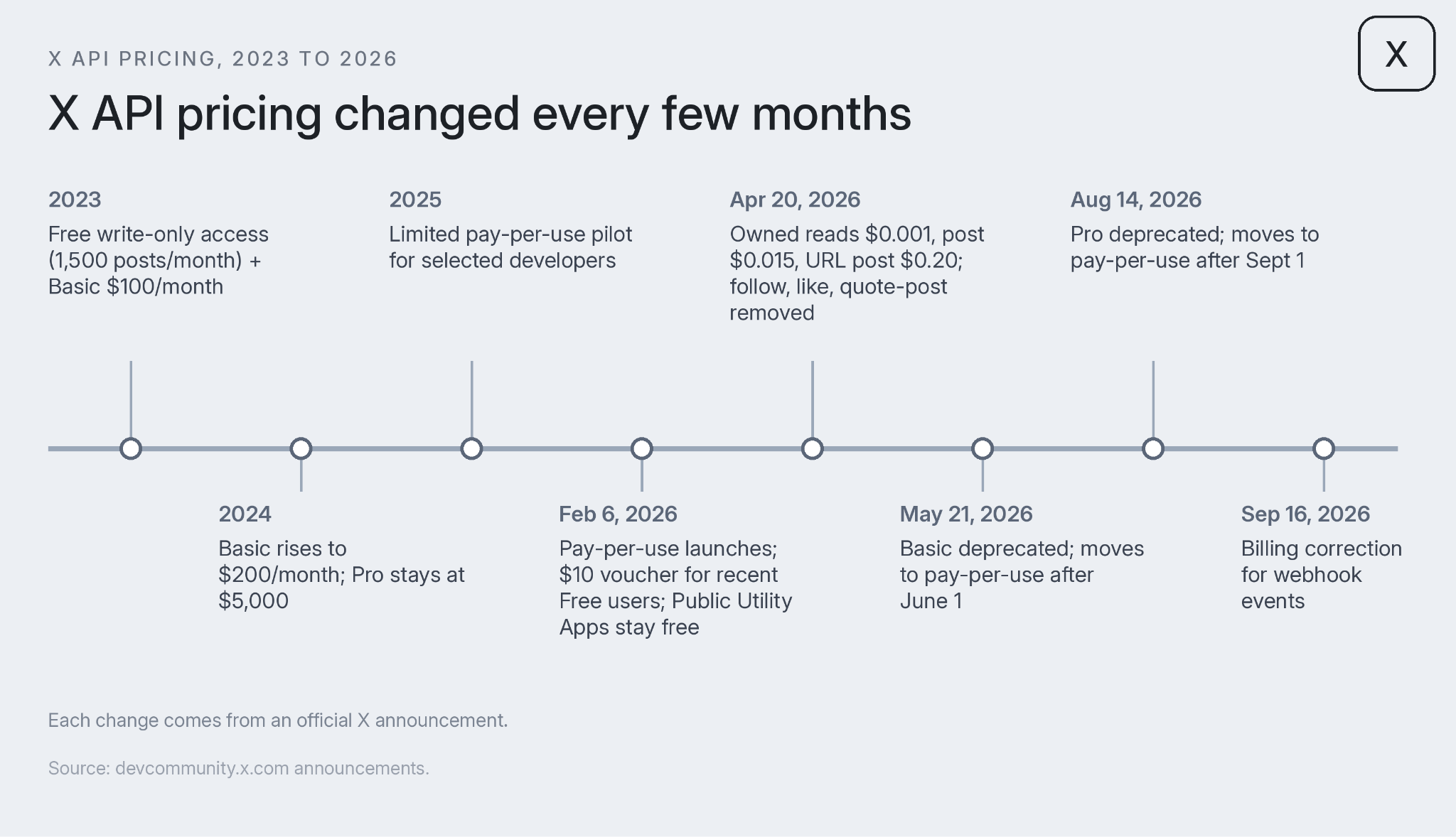
X has changed its API Twitter price several times since 2023. It moved from free access and fixed tiers to pay-per-use, and it deprecated the legacy Basic and Pro plans in 2026. Terms shift often, so here’s a timeline of the recent changes.
Monthly Basic and Pro subscribers moved to new terms at the end of their billing cycles, starting with credits equal to their old fee ($200 and $5,000), while annual subscribers received the remaining value of their plan as credits.
Current X (Twitter) API Pricing (2026)
X now charges per use. You prepay credits, and billable API usage reduces your balance. There is no subscription fee or minimum spend. X also offers promotional credits to eligible accounts. The Twitter API cost depends on the action: a standard post read costs $0.005, and a user profile read costs $0.010. This section shows how the credits work, where X sets limits, and what each action costs.
How Pay-Per-Use Works
With X API pay-per-use, the price list is only part of your bill. The other part is how credits behave: how they run out, when requests stop, and how daily deduplication can prevent repeat charges.
- Credits, auto-recharge and spending limits.
You buy credits in the Developer Console. Billable usage reduces your balance. The balance can go a little below zero. X then blocks requests until you add enough credits to cover the negative balance.
Auto-recharge runs at most once every five minutes, and it does not run when your balance is zero or below. So a fast job can still run out of credits. Reaching a spending limit blocks requests until the next billing cycle.
X does not bill failed calls, according to its Usage and Billing page. The GET /2/usage/credits endpoint shows your balance in USD, so you can use it to set up your own alerts.
- Batched requests and deduplication
X bills post reads per resource returned, not per search request. A response with 100 newly billable posts costs 100 × $0.005 = $0.50 at the standard rate. Normally, if you request the same post twice within one UTC day, you pay once. The window resets at midnight UTC. X calls this a "soft guarantee," so exceptions can occur.
- Free access
X launched pay-per-use pricing on February 6, 2026. However, Public Utility Apps keep their free access despite this change. Other accounts that do not fall within this category, should pay per use at the rates listed above.
- Free credits for new accounts
Eligible new accounts can earn $20 in free credits after their first credit purchase. X also matches the first successful auto-recharge, up to $50. These credits expire three months after X grants them, and saving a payment card alone no longer qualifies.
- xAI credits
Buying X API credits can also earn xAI API credits. Rewards depend on your total credit purchases during a billing cycle: 10% at $200-499, 15% at $500-999, and 20% at $1,000 or more. You must link your xAI team to your X developer account. These rewards are for the xAI API, not for X API requests.
The 3 Million Post Reads Cap
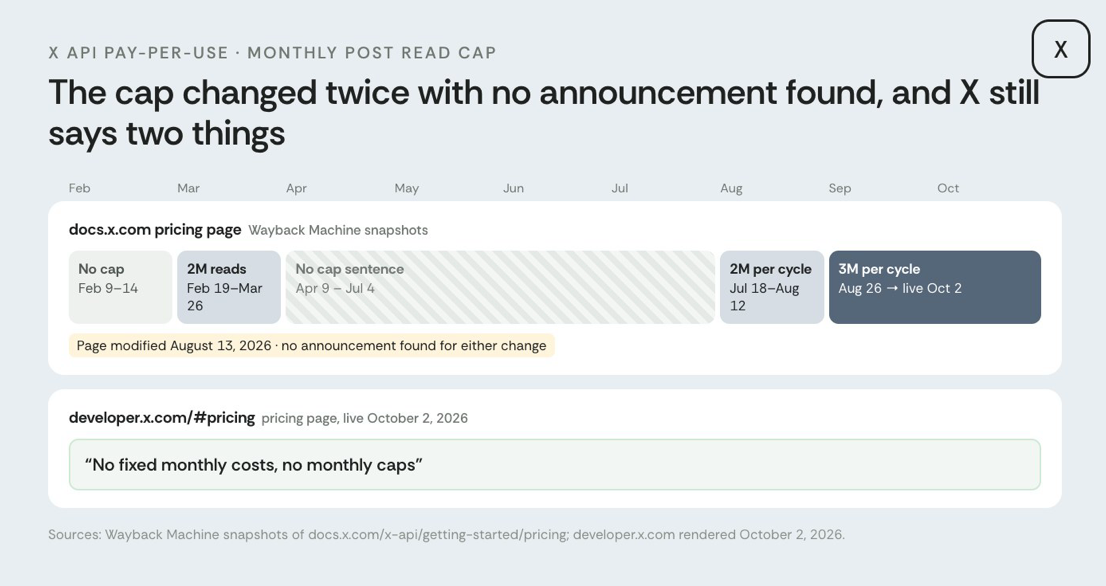
Credits are not the only limit on your usage. X also puts a ceiling on how many posts you can read. Its pricing page says pay-per-use plans "are capped at 3 million Post reads per monthly billing cycle." Developers who need higher volumes must use Enterprise.
At the standard rate, 3 million newly billable post reads would cost 3,000,000 × $0.005 = $15,000. This is an example of post-read costs, not a total account spending cap. Eligible owned reads cost less, while other actions have separate charges. Set a spending limit based on your workload and budget.
Enterprise Plan
Enterprise is the path past 3 million reads: a custom contract arranged through a sales form, with custom post read volumes and custom X API rate limits, according to the official pricing page. Still, the platform publishes no price. A figure of $42,000 a month, reported by Wired in 2023, still circulates, but treat it as dated. Volume isn't the only trigger, either: the X Developer Agreement says self-serve plans are meant for hobbyists and prototyping, or for apps "with a limited number of end-users," and sends anyone beyond that to Enterprise. More in our Twitter Enterprise API overview.
The X API Price List
X bills reads per resource returned and writes per request, so the X API price depends on the action. A response with 100 newly billable posts produces 100 post-read charges. A request that publishes one post produces one write charge. These are the published rates:
All rates above come from X's pricing documentation. Some webhook events, including post.delete, dm.sent, and dm.read, are not billed. The full price list on docs.x.com has more entries, including lists, spaces, bookmarks, and mutes. X says prices can change and directs developers to the Developer Console for current rates.
What Tweet Search Costs
Search can return many posts, so per-resource charges can add up quickly. At the published standard post-read rate, each newly billable post costs $0.005. Your estimated cost depends on how many posts come back and the applicable endpoint rate.
Full-archive search is available on pay-per-use, so you don't need Enterprise for it. The Usage and Billing page says prices may vary by endpoint type and data scope, including recent and full-archive data. Check the Developer Console for the rates that apply to your account.
In round numbers, 10,000 posts cost $50, 100,000 cost $500, and 1,000,000 cost $5,000. A full page of 100 recent-search posts costs $0.50, and a full 500-post archive page costs about $2.50.
Note: X's May 2026 search update removed retweets from keyword-based search results. If you need retweets, check X's current documentation for other ways to retrieve them.
Why Are Rate Limits Not Your Bill?
Twitter API rate limits and your bill are separate things. Limits control how fast you can send requests to each endpoint, usually in 15-minute windows, per app or per user. Go over a limit and X returns a 429 error until the window resets. Spending more doesn't raise them, and only Enterprise gets custom limits. For the full endpoint table and the headers that show your remaining room, see our Twitter API rate limits guide.
How Much Does the Twitter API Cost per Month? Four Illustrative Workloads
Twitter API cost depends on what you read and how much of it. These examples assume newly billable resources after deduplication, a 30-day month where applicable, and no additional billable resources or actions. We chose these examples to show the arithmetic; substitute your own volumes to estimate your costs.
All of this makes official data retrieval a real investment, and rarely an easy one for small or medium-sized projects. That's why many teams look for Twitter API alternatives that cover the data they need with a predictable bill.
Best X (Twitter) API Alternatives in 2026
Here are three alternatives, each suited to a different workflow. We selected them to cover different data volumes, levels of technical involvement, and budgets.
Data365
Data365 is a web data collection company, built for teams that need clean, structured data they can build on. Our API retrieves publicly available data from X and seven other networks (Instagram, Facebook, TikTok, Reddit, Pinterest, Threads, and Telegram) and delivers it as ready-to-use JSON. No X developer app to register, no OAuth flow, and no prepaid X balance to top up.
A request takes three calls: a POST starts a retrieval task, a GET checks its status, and a GET returns the results. Every network Data365 covers uses the same request flow and the same credit model. When a platform shifts its architecture, Data365's in-house engineering team works on the backend, so you don't rebuild your integration every few months.
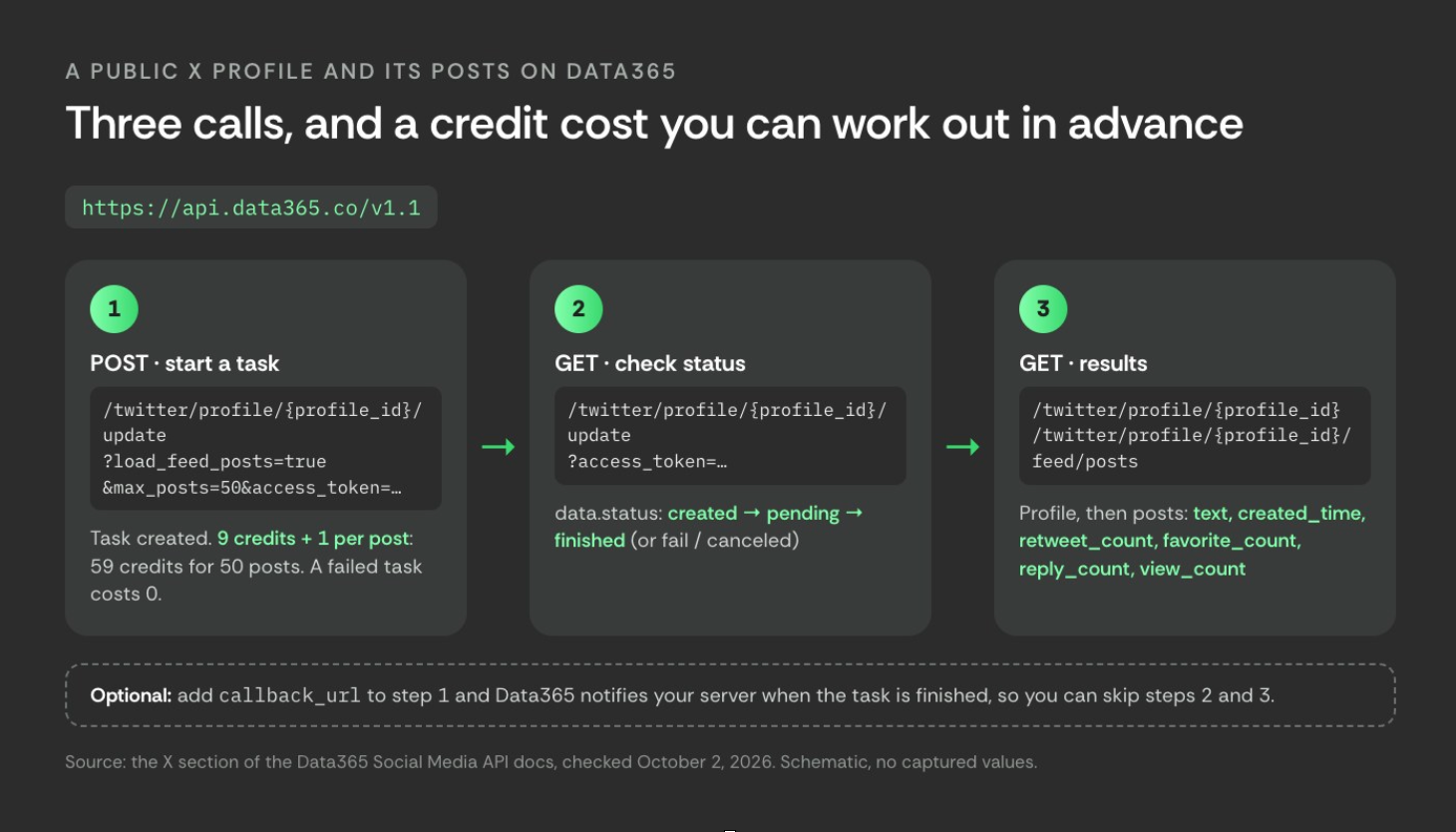
The information is collected at the moment of your request through stable endpoints such as:
- Twitter profiles
- Profile audience metrics
- Tweet content and reactions
- Tweet and profile media
- User tweet timelines
- Other public information
Pricing: €300–€850 a month, credit-based (1 credit per post, 9 per profile); Custom plans for more networks
Free option: 14-day trial, no credit card required
Worth knowing: public data only; some profiles and posts may stay inaccessible without a login. Data365 is independent and not affiliated with X Corp.
Curious what your own account list would cost? Book a quick call and the team will send you an API key for the 14-day free trial.
PhantomBuster
PhantomBuster is a cloud automation and data extraction platform from Paris. It runs ready-made automations, called Phantoms, on X, LinkedIn, Instagram, and other sites. You pick a Phantom, add your inputs, and get the results as CSV or JSON files.
Pricing: $69-439 a month; priced by execution time, slots, and credits
Free option: limited free plan
Worth knowing: most X Phantoms run through your own X account, connected with a session cookie. A Phantom can stop working when X changes its pages.
Octoparse
Octoparse is a no-code web scraping tool with a point-and-click setup. It also offers ready-made templates for popular sites, including X. You choose a template, enter a keyword or URL, and run it on your computer or in the cloud.
Pricing: $69-249 a month; Enterprise is custom
Free option: free plan, runs on your own device
Worth knowing: some templates need an X login or extra credits. A template can stop working when X changes its layout.
Whichever tool you choose, you are responsible for making sure your data collection follows the law and X's terms.
Data365 vs X (Twitter) Prices Compared
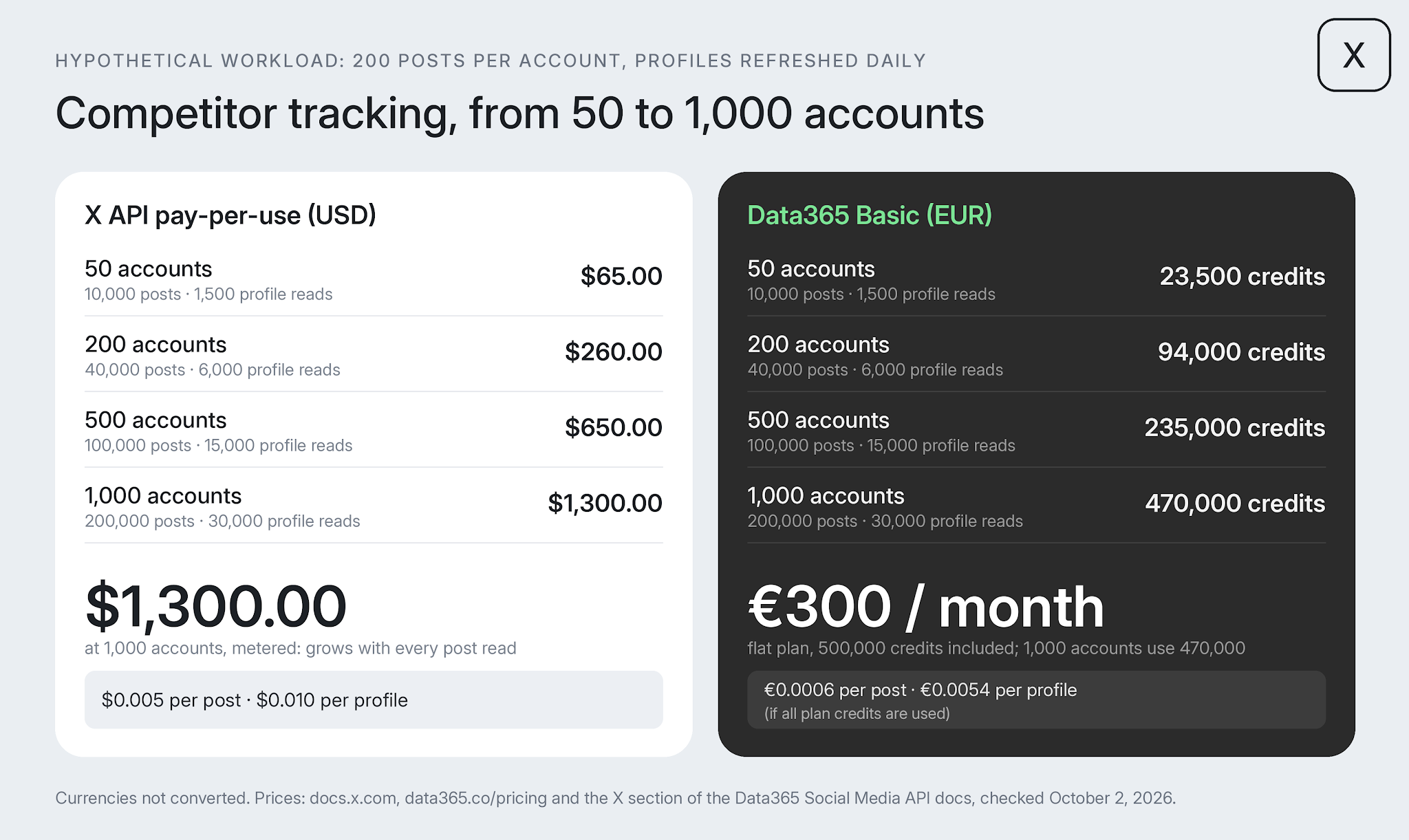
Data365 Social Media API charges in credits: 1 credit per post and 9 per profile, according to the documentation for X. The Basic plan is €300 a month for 500,000 credits, which is €300 ÷ 500,000 = €0.0006 per credit, or €0.60 per 1,000 credits. Here is what that buys:
These prices assume you use all 500,000 credits. The plan itself is a flat €300.
The question is how the two bills behave as you track more accounts. Here’s an illustration of such a scenario.
Here is the math for the last row. On X: 200,000 × $0.005 + 30,000 × $0.010 = $1,000 + $300 = $1,300. On Data365: 200,000 × 1 + 30,000 × 9 = 470,000 credits, which fits inside the 500,000 in the plan.
We kept the currencies separate and didn't convert euros to dollars. At 50 accounts, X's metered bill is the smaller one. The two bills meet at roughly 250 accounts, depending on the euro-dollar rate. After that, X's bill grows with every post and profile, while Data365's stays at €300 until the plan's credits run out. At 1,000 accounts, Twitter API costs roughly 3.5 to 4 times as much.
In addition to crystal-clear pricing, the Social Media API also adds a simpler workflow: no X developer app, no OAuth flow, and a credit-based plan that is easy to manage. Need more than 500,000 credits a month? Consider Standard (€850 for 1,000,000 credits across three networks) or Custom plans (seven networks and adaptable to your data requirements).
X (Twitter) API or an Alternative: How to Choose
X is still one of the richest sources of public conversation data, and the official API is only one of the ways of getting it. Pay-per-use made it easy to start, at $0.005 a post and $0.010 a profile. The X API cost grows in three places:
- Profiles and follower records: At $0.010 each, 20,000 profiles and 100,000 follower records cost $1,200 a month.
- Posts with links: At $0.20 each instead of $0.015, 300 posts cost $60 instead of $4.50.
- History pulls: One million archive posts cost $5,000.
So the right choice depends on what data you need, how much of it you read, and who maintains the setup.
Stay with X's official API when you publish, send DMs, read your own account's data at $0.001 an item, need webhooks or the filtered stream, or need anything X shows only to logged-in users, such as search results and follower lists. Small volumes favor X too: tracking 50 public accounts costs about $65 a month.
Consider Data365 when you track public profiles and their posts at volume, since a flat plan keeps the bill fixed while X's grows with every item. For a one-off export without a developer, a no-code tool like PhantomBuster or Octoparse can be enough.
Book a call with our tech team to learn more about Data365 and start a free 14-day trial. It's an easy way to see whether the Social Media API suits your project without paying.
Extract data from top social media networks with Data365 API
Request a free 14-day trial and get 20+ data types


