



There's a specific kind of frustration reserved for developers and data teams who go looking for Instagram data. It starts with confidence, and ends somewhere, staring at a Meta permission error, wondering how wanting a list of public posts turned into a compliance project.
Overview:
- The pattern Meta has followed since 2018 – Legacy API gone, Basic Display API gone, ongoing metric deprecations in 2025 – is not a bug. It is the strategy. Build accordingly.
- Instagram API keys and tokens come with rules – strict ones. They'll shape how you interact with the platform and how much engineering time you sink into the integration.
- Access, it turns out, and visibility are two different things on Meta's platform.
It didn't used to be an obstacle course. And before we get into what the credential system looks like today, it's worth a moment of honest acknowledgment: if you're reading this hoping to find your way back to a simpler time, that train has left. So, let’s see what kind of transportation to the Instagram public data we take these days.
What Changed in 2024-2025
For years, Instagram offered a relatively painless entry point for developers: the Basic Display API. It was lightweight, straightforward, and let you pull public profile data and media from any Instagram account with a simple OAuth flow. Personal accounts worked. A Facebook Page wasn't required. App review was minimal. It wasn't perfect, but it was manageable.
On December 4, 2024, Meta shut it down permanently. If you have had an integration built before 2025, haven’t migrated it, and decided to dust it off in 2026, it has already broken.
What replaced it is the Instagram Graph API: more powerful, more capable, and considerably more demanding. It requires a Business or Creator account, a linked Facebook Page, a registered Meta app, and, for most production use cases, a formal app review process that can take anywhere from a few days to several weeks, with no guarantee of approval on the first attempt.
Two Credentials, One Headache: API Keys vs. Access Tokens
Before touching a single endpoint, you need to understand the two types of credentials the Instagram API system uses because conflating them is one of the more expensive mistakes you can make early in a project.
An API key is a static, application-level credential. It identifies your app to Meta's systems. Think of it as your app's permanent ID badge: it doesn't change, it doesn't expire on a schedule, and it doesn't carry any information about which user's data you're accessing. It's what you use during setup, server-to-server authentication, and scenarios where you're accessing data at the app level rather than on behalf of a specific account.
An access token is a different beast entirely. It's dynamic, time-limited, and user-specific. It's issued after a user goes through OAuth authorization and explicitly grants your app permission to access their account. It carries those permissions with it, which means it can do things an API key alone cannot – read posts, pull analytics, interact with comments. It's also the thing that expires, needs refreshing, and will cause your production integration to silently die if you forget about it.
In practice, most integrations need both. The API key gets you registered and recognized. The access token is what actually opens the door to data. Understanding where one ends and the other begins will save you a meaningful amount of debugging time later.
Getting Access: The Setup Nobody Warned You About
Here is the complete list of things you need before your first authenticated API call returns anything useful.
- You need a Meta Developer account to show Meta that you don't plan to create the next Cambridge Analytica scandal. Not an Instagram account – a Facebook for Developers account, because Instagram's API lives inside Meta's platform infrastructure and plays by Facebook's rules.
- You need a Business or Creator Instagram account. Personal accounts have been locked out of the API entirely since December 2024. If the account you need data from is personal, the only path forward is converting it, which is free but requires the account owner's cooperation.
- You need a Facebook Page linked to that Instagram account. This is the step that surprises people most. Instagram and Facebook are the same company, but linking the two requires deliberate configuration, and without it, the Graph API will not recognize your Instagram account as a valid connected entity.
- You need to register an app in the Meta Developer portal, specifying its type, its use case, its redirect URIs, and the permissions it will request. This is where you also generate your API key (App ID and App Secret).
- You need to select and justify your permission scopes. Basic read access is relatively easy to get. Anything touching analytics, insights, or content management requires explaining your use case to Meta in enough detail that a reviewer can verify it. Requesting permissions you can't clearly justify is the fastest path to rejection.
And then, for most production apps, you need to pass Meta's app review. This means submitting screen recordings of your app in action, a privacy policy, detailed use case documentation, and waiting. Approval takes two to seven days in straightforward cases. Rejections, which are common and often come down to unclear screencasts or a mismatch between requested permissions and demonstrated use case – restart the clock entirely. The full process, including a rejection or two, realistically runs four to six weeks.
At this point, you have not yet written a single line of production code that does anything with Instagram data. You have completed the prerequisites.
The Token Treadmill
Now that you're through setup, here is what keeping your integration alive actually looks like.
The OAuth flow issues a short-lived token first, valid for one hour. This is your initial handshake, useful for testing but not for anything that needs to run past the next sixty minutes. You exchange it immediately for a long-lived token via the Graph API's /access_token endpoint. This gives you sixty days.
Sixty days sounds like plenty. It isn't, once you account for everything else happening in your infrastructure. The critical constraint that Meta's documentation mentions and most developers discover too late: a long-lived token can only be refreshed if it is at least 24 hours old and has not yet expired. Miss that window – let the token lapse – and there is no recovery path. You go back to the full OAuth flow and start over.
The practical standard for production systems is to refresh every 50 days. That means building and maintaining a scheduled job, monitoring it, alerting on failures, and handling the edge cases.
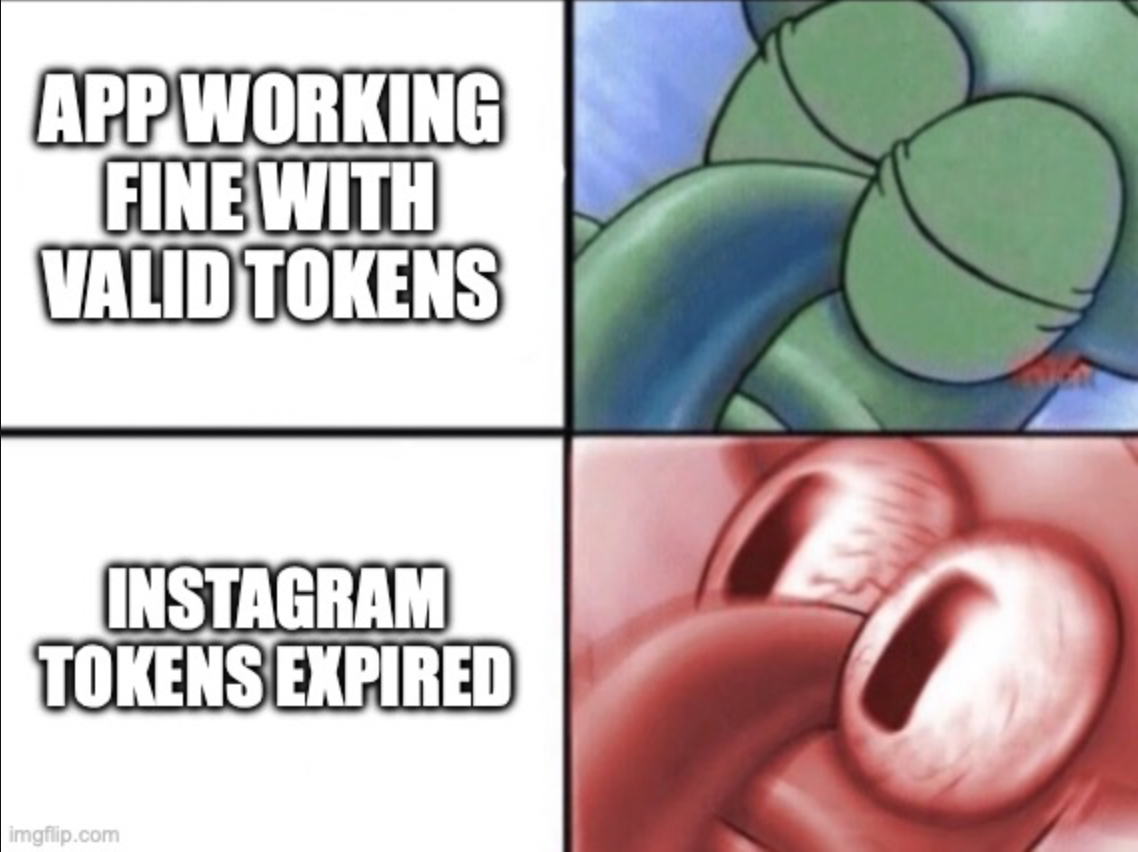
For a single integration serving one account, this is annoying. For a platform serving dozens or hundreds of accounts, each with its own token lifecycle, it becomes a dedicated engineering responsibility. You are not pulling data anymore. You are operating a token management system that happens to pull data as a side effect.
A Word on Security
Tokens are credentials. Treat them accordingly. They belong in encrypted server-side storage, not in client-side JavaScript, not in .env files committed to public repositories (Meta actively scans GitHub and will invalidate exposed tokens automatically), and not in Slack messages to your team.
Set up expiry monitoring. An expired token that fails silently – returning empty data rather than an error – is worse than one that fails loudly, because you may not notice for days. Build alerting. Rotate on schedule. Assume the token will expire at the worst possible moment, because it will.
Data365: Not Every Data Problem Needs to Be an Infrastructure Problem
At some point, it's worth doing a clear-eyed accounting of what you're actually trying to accomplish.
If you need to manage your own Instagram presence programmatically – publishing posts, moderating comments, analyzing your own audience demographics – the Graph API is the right tool, and the setup cost is justified. You're building infrastructure for ongoing account management, and the credential complexity is a one-time investment.
But a significant share of the teams that end up fighting through this process have a simpler goal: they need publicly available Instagram data. Profile information, post performance, engagement metrics – the kind of data that is, in principle, already visible to anyone with an Instagram account. And for that use case, the full Graph API stack – developer accounts, Facebook Page requirements, app review, the token treadmill – is an enormous amount of infrastructure for what is functionally a data access problem.
That's the gap Data365 was built to fill.
Data365's Social Media API provides structured access to public Instagram data without requiring you to register a Meta app, manage OAuth flows, or maintain a token refresh system. Beyond simplicity you get:
- Data365 is built to surface a wider and deeper range of public data than you'd typically piece together on your own.
- Different social media platforms unified under a single, consistently structured API layer. No context-switching between docs, no reformatting data from six different schemas. You define what you need at what network.
- Whether you're running a lean research project or an enterprise-scale pipeline, the infrastructure scales with you. Share your requirements – the infrastructure adapts accordingly.
- No cached datasets, no stale snapshots. Every call retrieves publicly available data at the moment you make it – with the option to access historical public posts when available.
- Data arrives structured and formatted in clean JSON – reflecting what is publicly available on the platform.
The honest comparison isn't "Data365 vs. the Instagram API." It's "Data365 vs. the total cost of building and maintaining your own Instagram API integration," including engineering time, infrastructure overhead, the periodic disruption every time Meta deprecates something (and they will), and the opportunity cost of your team managing credential hygiene instead of doing analysis.
For teams focused on research, competitive intelligence, brand monitoring, or any use case built around public data at scale, that math usually resolves quickly.
Conclusion
The Instagram API is a capable, well-documented system, and for teams building account management tools, publishing workflows, or audience analytics on their own presence, it is genuinely the right tool for the job.
For everything else, the credential system is worth understanding clearly before committing to it. API keys establish your app's identity; access tokens establish user-level access. Both are necessary, both require ongoing attention, and the setup that precedes them – accounts, linked pages, app registration, permissions, review – is a real investment of time before you see a single data point in return.
If that investment matches what you're building, go in prepared and build the token management infrastructure properly from day one.
If you're here because you need publicly available Instagram data and the API keeps getting in the way of that goal – talk to Data365. Sometimes, the right answer to an infrastructure problem is not to have the infrastructure problem.
Extract data from top social media networks with Data365 API
Request a free 14-day trial and get 20+ data types





.svg)
.svg)
.svg)


.svg)
.svg)
.svg)
