



As of September 2025, Instagram had crossed 3 billion monthly active users, each one leaving a trail of opinions, preferences, and purchase signals in the comments. For marketing teams, that Instagram comments section is one of the richest, most unfiltered sources of consumer intelligence available.
The challenge is scale. Manually reading comments on a campaign post is feasible. That is where an Instagram comment scraper or API becomes an irreplaceable tool, not just a “nice to have” novelty.
Data365’s experts have prepared this article for marketing strategists, brand managers, and growth teams who need to understand what Instagram scraping actually delivers, how to approach it responsibly, and how to evaluate the right approach for their stack.

Short Overview
- An Instagram comments scraper is a tool used to programmatically fetch the content of the comments, the comment time, the like count, and the usernames.
- Sentiment analysis, brand monitoring, influencer audience validation, and competitor analysis are core use cases that are based on comment data.
- Best practice approach: employ a third-party API for social media as it is reliable, scalable, and easily integrated.
- Alternatives (custom Python scraper or no-code online comment scraper) are hard to maintain and can easily be broken by Instagram's infrastructure updates.
- Key evaluation criteria when choosing a data retrieval tool include data freshness, scale/reliability, structured output, and integration.
What Does an Instagram Comment Scraper Actually Collect?
An Instagram comment scraper is a tool/service that allows you to extract information from Instagram comments from public posts at scale. It gathers thousands of data points in minutes, puts them into a structured format for analysis, unlike manual review.
Common data returned are:
- Comment text (to detect the core sentiment signal)
- Timestamps (to provide trend analysis over time)
- Like counts on comments (to spot a community resonance)
- Username (to profile the target audience and check influencer relevance)
This data can be aggregated to enable sentiment analysis, comparing campaign performance, looping customers back through to the campaign, and keeping up to date with competition intelligence — without conducting a single survey or waiting for the quarterly report.
Instagram Comments Scraper: 4 Core Applications for Marketing Teams
Instagram comments are a high-velocity, high-fidelity source of customer opinions that marketing teams can convert into rapid, actionable insights. Here are the core activities teams incorporate into their work routine:
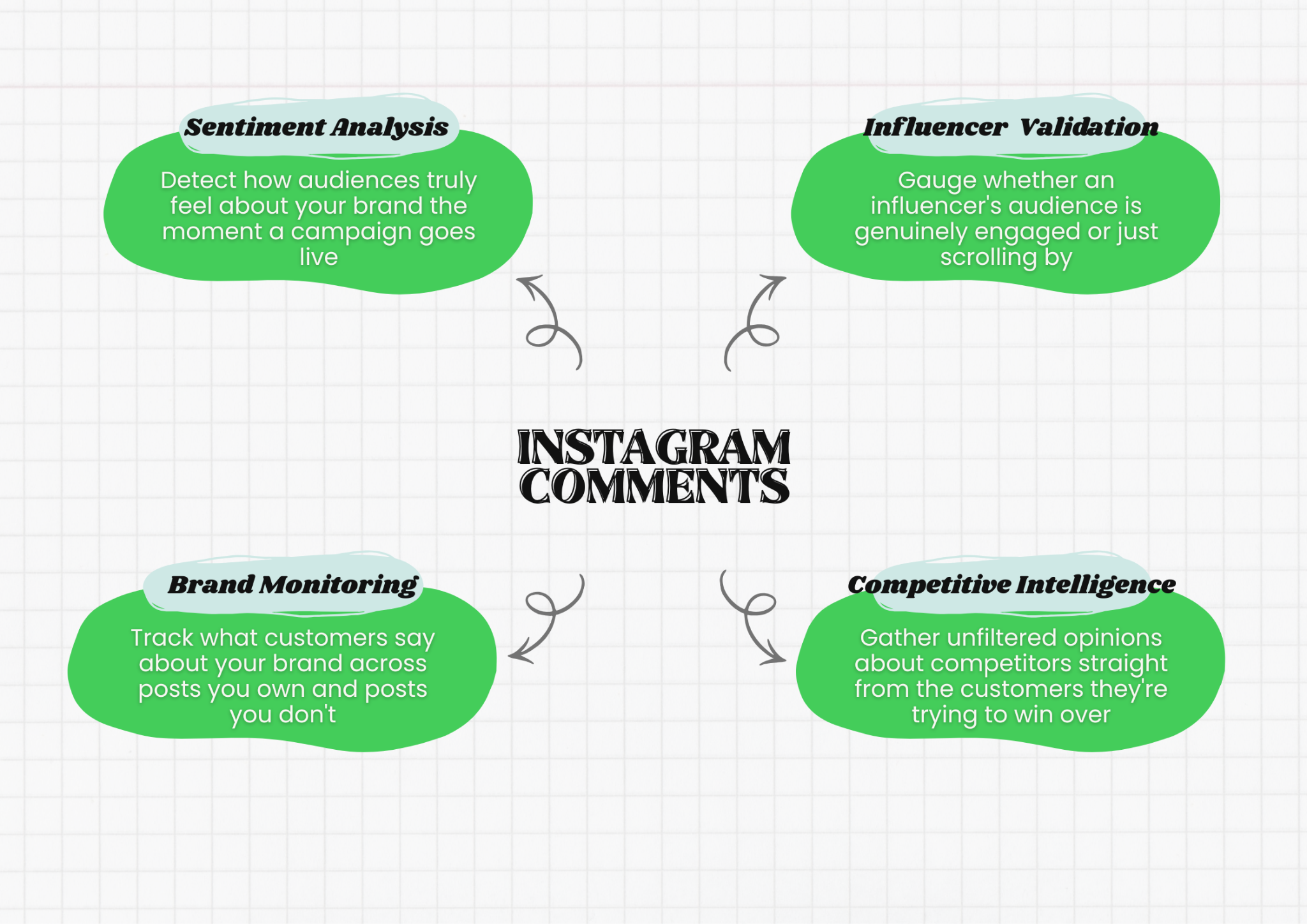
1. Sentiment Analysis at Campaign Scale
Traditional brand tracking surveys take weeks and give you a snapshot. Instagram comments give you a rolling, real-time signal. By running sentiment analysis on scraped comment data, marketing teams can detect shifts in brand perception within hours of a campaign launch — and adjust messaging, creative, or targeting before the spend compounds a mistake.
2. Brand Monitoring Across Owned and Earned Media
Your brand is discussed on accounts you don’t control — by customers, critics, and creators. An online comment scraper lets you monitor all of it systematically: tracking volume, tone, recurring complaints, and emerging praise across your entire brand footprint on the platform.
3. Influencer Performance Validation
Engagement rates on influencer posts are notoriously gameable. Comment quality is much harder to fake. Before renewing a partnership (or signing one), scraping comments from an influencer’s recent posts gives you a far more reliable read on their actual audience relationship: Are comments substantive? Are followers asking purchase-intent questions? Is the brand mention generating real conversation or just polite noise?
4. Competitive Intelligence
Your competitors’ comment sections are a public research lab. What are customers praising? What keeps coming up as a frustration? An Instagram comment scraper applied to competitor posts surfaces the kind of unfiltered product and service feedback that their own internal teams may not even be seeing clearly.
With all these vital business activities, choosing how to collect that comment data becomes important. The next section compares comment scrapers, Instagram and third-party APIs, and custom scripts so you can pick the approach that fits your scale, compliance, and engineering constraints.
Comment Scraper, Instagram APIs, and Custom Scripts: How Each Approach Works
The method for collecting data is the technical foundation of any comment-driven insight program: it is what the size, reliability, and downstream value depend on. The most important observation tools are:
API-Based Approach (Recommended)
For a majority of marketing teams, the most reliable and scalable way to get this data from Instagram is via a dedicated third-party social media API — an API that provides you with the infrastructure to gather the data and provides you a clean, structured output to your Analytics stack.
The sequence of a typical workflow is as follows:
- Choose a provider. Look for a service with strong operational speed, high-quality data, and the endpoint types you need.
- Get API credentials and learn documentation. Review the authentication methods, request formats, and available endpoints.
- Configure your request. Pass in target profile URLs/alternative post identifiers, desired data fields, and output format preferences.
- Make the API call. The service retrieves publicly available data and returns it in a structured format, including the text, date, user information, and engagement statistics.
- Convert and forward data. Connect to your analytics, CRM, or BI system for reporting and activation.
It is technically simple and is the best option for teams that do not wish to develop their own scraping system and need a consistent and large volume of data.
Instagram Graph API (Official, Limited)
Instagram Graph API is Instagram's official data access API. It is meant for business and creator accounts and allows a limited retrieval of comments that you own. It is not useful for competitive research or widespread data collection, as it does not provide access to other accounts' comment data and requires the app's permissions approval.
Python-Based Custom Scrapers
Teams with engineering resources sometimes build custom scrapers using browser automation frameworks. These can be effective for small-scale or exploratory work but require ongoing maintenance as Instagram updates its front-end structure, and they are vulnerable to detection and blocking. Data quality and continuity tend to be inconsistent at anything beyond proof-of-concept scale.
No-Code Scraping Tools
Several platforms offer GUI-based scraping without requiring code. They carry the same structural vulnerabilities as custom scripts — Instagram’s anti-scraping measures affect them equally — and output may lack the fidelity needed for serious analytical work. A reasonable starting point for experimentation, but not for production use.
Next, we’ll show how those collection choices play out in real-world projects with three clients who used Data365 Social Media API and turned comment data into decisive business actions.
Scraping Instagram Comments: Three Scenarios That Change Real Decisions
Abstract use cases only go so far. Here is how three real Data365 clients turned social comment data into decisions that changed how they work.
Case 1: Neticle — When Sentiment Analysis Needs a Reliable Data Feed
Neticle is a Hungarian media monitoring company whose core product is a Text Analysis API that delivers sentiment scores, topic detection, emotion recognition, and brand detection at human-level precision. The problem was upstream: their analysis engine was only as good as the data fed into it, and sourcing consistent, high-volume social media comment data — including Instagram comments — at scale was slowing them down.
By integrating Data365's Social Media API, Neticle gained access to comment and response data returned as structured fields: language, engagement metrics, hashtag lists, and reaction breakdowns. That feed became the raw material for their NLP pipeline — comment text in, sentiment intelligence out. For Neticle's clients in corporate communications and market research, the result was real-time brand perception tracking built on comment data that actually reflected what audiences were saying, not a sampled or delayed approximation of it.
Read the full Neticle case study →
Case 2: Buzztech — Scaling Social Intelligence Without Scaling the Bill
Buzztech is a 13-year-old Italian social intelligence company serving enterprise clients across Pharma, FMCG, Travel, and Corporate Affairs. Their platform monitors digital conversations at scale and translates them into insight dashboards for brand managers and communications teams. As their client base grew, their data pipeline hit two walls simultaneously: cost and coverage.
Existing data vendors either delivered pre-processed, sampled outputs that limited analysis depth, or charged pricing that made scaling prohibitive. Language filtering for multilingual clients was inconsistent. Engagement history tracking was incomplete. After testing multiple vendors, Buzztech integrated Data365's API — and the numbers followed. Data acquisition costs dropped by 30%. Coverage expanded across key social platforms through a single integration. Alert response times improved. Client retention strengthened. The switch wasn't just a vendor change; it restructured the economics of their entire intelligence operation.
Read the full Buzztech case study →
Case 3: Metricform — Intelligence Reports That Can't Wait on the Data Pipeline
Metricform is a US-based SaaS company that builds strategic intelligence products for executives — tools that transform fragmented online narratives, including social media comment data, into structured analysis of market shifts and reputational signals. The product vision was sharp. The data infrastructure was not keeping up.
Analysts were spending disproportionate time preparing and stitching data rather than interpreting it. Manual high-volume workflows were extending time-to-market for reports. The company needed a data backbone that could match their product ambitions, not constrain them. After integrating Data365's Social Media API — with 99.9% uptime, real-time access across major platforms, unified schemas, and constant back-end support ensured by an expert team — the bottleneck was cleared. Data prep time dropped. Report development accelerated. New product features moved from slow rollout to confident, on-schedule execution.
Read the full Metricform case study →
Choosing the Right Tool: What to Evaluate
As you can see, not all Instagram scraping services are equal, and not everyone can demonstrate their expertise through their work. When evaluating a third-party API solution, the criteria that matter most to marketing teams are:
- Data freshness (how fresh is the data?)
- Scale and reliability (can it handle large-volume requests without degradation?)
- Structured output (does it provide clean and consistent data fields, or unstructured output?)
- Integration options (will it integrate seamlessly with your current analytics or CRM system?)
These requirements were the main reason for the creation of Data365's Social Media API, which automatically scales to handle heavy loads, provides timely data feeds, and structures the output for seamless integration into analytics workflows. We provide a 14-day free trial if you'd like to trial it with your unique case, after a quick call.
Extract data from top social media networks with Data365 API
Request a free 14-day trial and get 20+ data types


.svg)
.svg)
.svg)


.svg)
.svg)
.svg)
