



Businesses aligning marketing strategies with real-time social media insights outperform competitors threefold. And it’s simple to explain: brands that listen to their customers and know what they need build deeper relationships and loyalty.
The challenge? Consumer decision-making has become a dynamic phenomenon that changes daily, not quarterly. And that requires a robust and efficient data retrieval instrument.
However, most businesses often fall behind on building a reliable process of getting social media insights due to poor tool selection. It is often a decision between a social media scraper (which breaks often) and an API (which can seem costly) without a clear understanding of which model would best serve their needs.
This guide covers:
- Brief explanation: what scrapers and APIs are.
- APIs vs scrapers: 3 scrapers and 3 APIs handpicked and compared.
- Decision model: aligning the business needs with different applications.
- Final thoughts on social media data retrieval process.
Data365 will help to figure out what works best for your specific case.
Social Media Scraper and API: Types and Differences
This part examines the technical basis of two data collection tools. First, we will discuss the operational principles of scrapers, their types, and the data they retrieve. We will also examine APIs as an alternative solution and show the main difference between these two instruments, so that you can select the right option for your specific case.
Social Media Data Scraper: Principle of Work and Variations
Scrapers are systems that use a reverse-engineering method to retrieve public data from digital platforms by making automated HTML requests and targeting requested data points. They are often used to get insights from Reddit, Twitter, Instagram, Facebook, TikTok, and others.
Social media scrapers enable users to fetch a variety of data types, including:
- Public user profiles (usernames, bios, followers/following count)
- Textual content (posts, comments, captions)
- Media (images, videos)
- Engagement metrics (likes, shares, comments)
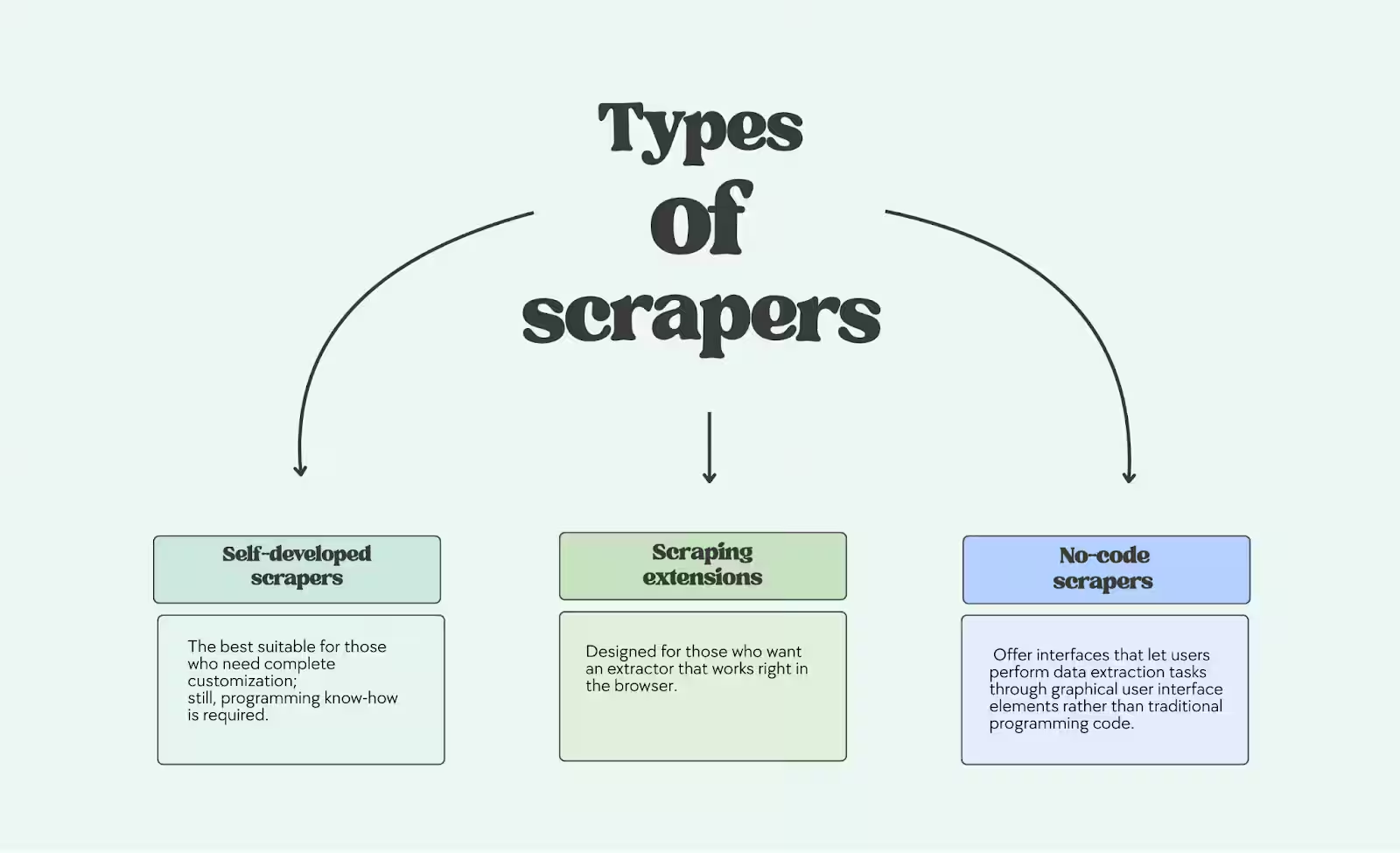
In general, scraping tools for social media come in multiple formats that meet diverse user needs and proficiency levels. Thus, businesses can choose from:
- Self-developed scrapers
- No-code scraping tools
- Scraping extensions
And while scraping is often confused with malicious hacking, most social media data scraper tools are designed to crawl publicly available website information. In contrast, hacking involves unauthorized access to private account data.
Social Media APIs as Scraper Alternative: What Sets them Apart
APIs (Application Programming Interfaces) provide a standardized way to access social media information. Unlike social media scrapers, APIs include official and third-party options, each with its own advantages and disadvantages. To be said, third-party APIs are often developed as replicas of the official API offered by the social network, though with more scalability, speed, and technical support.
There are two major types of API developed to collect social media data:
- REST APIs — utilize automated HTTP requests to access data in an uncomplicated resource format. The endpoints are specific to the data type (posts, comments, user profiles) and are therefore intuitive and platform-wide.
- Graph APIs — use the nodes-and-edges model for data retrieval. Graph APIs are good for accessing relational data, such as public posts with their comment threads or the profiles of commenters, in a single request.
Unlike scrapers, which read websites in a browser to locate needed data points and extract information, APIs target stable, predefined endpoints to retrieve information more reliably.
Another difference is that scrapers usually use dozens of actors for different purposes: one to scrape Instagram posts, another to extract Facebook stories, etc. This approach demands a constant learning curve and time-consuming setup for each new actor.

In contrast, APIs are unified systems that provide a single interface or very similar scripts to fetch data from different social media platforms via all popular endpoints, making them much easier to set up and maintain.
You can also decide which tool will be a better fit in your situation by checking our illustrative table below:
| Situation | Better choice |
|---|---|
| Enterprise monitoring where stability and scalability matter | API |
| One-time extraction or short-term projects with limited budget | Scraper |
| Non-technical teams that need quick setup but accept limitations | No-code scraper |
| Continuous analytics and automated reporting workflows | API |
| Testing ideas or validating hypotheses before scaling | Scraper / No-code |
Now, knowing what each of the mentioned data retrieval instruments offer, let’s head to the best products from these two categories in 2026.
Top 6 Social Media Scrapers & APIs in 2026
We've handpicked three leading APIs and three top social media data scrapers based on reliability, pricing flexibility, and real-world performance. Each tool has a different purpose and structure — from developer-friendly platforms to no-code solutions — so you can find the right fit for your data collection strategy.
The Best Social Media APIs
These are the three APIs we consider the strongest picks for social media data access.
Data365
Engineered exclusively for major social networks, the Social Media API by Data365 leverages 8+ years of experience retrieving and processing data from Facebook, Instagram, TikTok, Reddit, X (Twitter), and Threads into structured, actionable output.
Date established: 2018
G2 rating: 4.8/5
The key advantages of Data365’s Social Media API include:
- Transparent pricing: clearly credit-based for defined data types; starts at $0.60 per 1,000 records (vs. industry avg. of $0.98), with rates decreasing as volume rises.
- Unified tool: Single, consistent setup across platforms — no repeated scraper configurations.
- Proven reliability: A dedicated engineering team tracks platform changes in real time, maintaining 99% uptime.
- No hidden infrastructure expenses: everything necessary to access social platforms reliably is already included — no third-party tools, no additional fees.
- Scalable customization: Scales effortlessly to requested volumes with added fields/parameters as needed.
Free trial: 14-day trial with a full-potential API access (no credit card required; exact call volume determined during call with technical manager.)
Pricing: Public credit-based tiers available: Basic ~EUR300/mo, Standard ~EUR850/mo; Custom — to negotiate during a call.)

Phyllo
Phyllo is a creator data API that delivers and analyzes live data feeds from over 20 networks, including Instagram, YouTube, TikTok, and Twitch. It is widely used for influencer vetting, social screening, brand safety checks, and creator income evaluation, as well as for social KYC and visa vetting. The tool has a strong inclination toward influencer marketing channels and financial checks; less suitable for large-scale social data mining.
Date established: 2021
G2 rating: 4.5/5
Free trial: Available
Pricing: Custom, based on API call volume and platform coverage.

EnsembleData
EnsembleData is a unit-based API which provides access to Twitter, Instagram, Threads, Reddit, and other popular networks (excluding Facebook). It has monthly subscriptions with daily unit limits based on the plan that resets each day. Unit costs vary from 1 to 10 per endpoint for basic calls, but can rise to hundreds for larger amounts of posts or profiles.
Date established: 2020
G2 rating: n/a
Free trial: Available
Pricing: Public unit-based subscription plans available: from $100 to $1400 per month.

Top Social Media Scrapers
Below you’ll find our top-3 picks among scrapers designed for social media data access.
Bright Data
A platform that provides proxy and web scraping solutions with the ability to build API requests for fetching social networks via its interface. BrightData also offers access to SERP and browser scrapers; however, its subscription plan is slightly pricier than other offers on the market.
Date established: 2014
G2 rating: 4.6/5
Free trial: Available
Pricing: Pay-as-you-go: $1.50/1K records; committed plans from $499-$1,999/month.

Octoparse
A visual, no-code social media scraper with local and cloud execution. Users build workflows via a point-and-click interface; plans include task limits, concurrent cloud processes, and premium features such as residential proxies, IP rotation, and auto-CAPTCHA solving.
Date established: 2016
G2 rating: 4.8/5
Free trial: 14-day premium feature trial.
Pricing: Standard from $69/mo billed annually; Professional $249/mo billed annually; Enterprise custom.

Apify
Marketplace of social media scraper tools billed via Compute Units (CUs). Offers paid plans with monthly credits, discounted CU rates at higher tiers, proxy access, and a marketplace of pre-built "Actors."
Date established: 2015
G2 rating: 4.7/5
Free trial: Available
Pricing: Starter $29, Scale $199, Business $999; usage-based overages apply.

All pricing verified February 2026. "From" prices reflect entry-level paid plans billed annually, where applicable; "to" reflects the highest publicly listed tier. Always confirm current details on provider sites before committing.
With each product detailed, let’s now see the pros and cons of each and match them to specific business requirements.
Evaluating Social Media Scrapers: Pros, Cons, and Suitability
Having a detailed dossier on each platform is half the battle. Still, knowing their strengths and weaknesses will prevent wasting time and money on the tools that can appear to be the wrong solution.
The comparison table we have compiled below includes the advantages and disadvantages of each social media scraper and API, and explains which kinds of businesses will be best served by the functionality of the instrument.
| Product | Pros | Cons | Best suited for |
|---|---|---|---|
| Data365 |
• Unified access to primary social networks • 99% uptime & flexible scalability • Built-in error handling • Custom pricing plans • Live technical support |
• Requires basic technical integration skills | Developers, marketing, research, analytical teams with tech-savvy experts |
| Phyllo |
• Aggregates social monitoring and social listening tools • Normalized data across sources • Strong for influencer analytics |
• Custom pricing lacks transparency • Business trial requires approval |
Influencer marketing teams, PR agencies and brands |
| EnsembleData |
• Documentation available on the website • Open-source SDKs |
• Documentation gaps reported across some endpoints • Confusing “unit-based” pricing • Daily request limits |
Developers needing multi-platform social data but comfy with doc and pricing quirks |
| Bright Data |
• Pay-per-record clarity • No monthly commitment required • Handles CAPTCHA and anti-bot measures |
• Expensive at the very beginning • Complex pricing with multiple variables • Overwhelming feature set for simple needs |
Large enterprises with complex scraping needs |
| Octoparse |
• No coding required (visual interface) • Free plan available indefinitely • Built-in proxy and CAPTCHA solving |
• Breaks when websites change structure • Limited scalability compared to APIs • Task and export limits on lower tiers |
Small businesses with one-time or periodic data collection projects |
| Apify |
• Extensive marketplace of pre-built actors • Pay-as-you-go flexibility |
• Learning curve for each different actor • CU-based pricing can be confusing • Actors may break with platform updates |
Developers comfortable with scrapers |
Armed with these insights, you can make an informed choice that suits your unique business needs, based on a clear understanding of each tool's benefits, drawbacks, and optimal conditions for use. And while the correct instrument choice is only the start, this step often defines whether your strategy will be a win or a waste of money.
Now, let’s draw the line and summarize these insights into actionable takeaways.
Final Thoughts on Social Media Scraping: What’s Next?
Social media data retrieval has become more of a business need than a competitive advantage. Companies that gather and process customer insights consistently are able to make quicker and more informed decisions without lagging behind market shifts.
Our professional team has specified four key steps to the selection of the appropriate data retrieval tool so you can choose your extractor successfully:
- Understand your data requirements: determine what platforms, endpoints, and volume of data you need.
- Estimate technical capacity: evaluate whether your team can handle API integration or if no-code solutions are required.
- Think about scale: projects can expand, so should the amount of data; make sure that your tool has the ability to scale as you require.
- Assess long-term costs: summarize ownership costs such as set-up, maintenance, and scaling.
Data365 will be glad to become your reliable data retrieval partner. Our team can bring expertise and trustworthiness to every request, whether you need a consultation or a robust API to fetch Instagram, Facebook, TikTok, and more.
Plan a call with Data365 so we can discuss your specific needs and find ways to streamline your data-gathering process on social media.
Extract data from top social media networks with Data365 API
Request a free 14-day trial and get 20+ data types


.svg)
.svg)
.svg)


.svg)
.svg)
.svg)
