


You are a marketer who wants to monitor the conversations about your brand on Facebook. Or a developer designing a social listening tool. Anyway, after a while you end up typing in a similar query: “Facebook Search API.” However, this solution does not exist anymore in its former form. Yet, did it exist at all?
In this article, we’re about to figure out:
- the popular misconception of the Facebook Graph Search API
- why Meta has effectively stopped allowing anyone to search public posts
- what is left today via the official Meta tools (search on Pages, for example)
- and what users are saying about it + third-party tools/self-developed solutions
Data365 OÜ is an independent company. Our product, Social Media API, provides access to publicly available data but is not affiliated with, endorsed by, or officially connected to Meta Platforms, Inc., Facebook, or the official Facebook Graph API.
Short Overview
- No official "Facebook Search API" exists. It's a search-intent phrase, not a real product.
- Public post keyword search was removed in 2015.
- 2018 lockdown further restricted phone/email lookup and public content discovery post-Cambridge Analytica.
- Graph Search (people search) was fully deprecated by 2019.
- The official Facebook API search scope today only covers Pages, Places, and Events.
- Page access now requires a gated, review-based permission.
- Ad Library still supports real keyword search: global for political ads, UK/EU-only for commercial ads. The EU stopped new political ad entries in October 2025.
- Meta Content Library offers broader access, but only for academic/nonprofit researchers.
- Developer forums show frustration, with responses split between in-house scraping and third-party tools.
Facebook Search API: What “Search” Actually Means Across Official and Third-Party Tools
The reality is that there's no product with such a name in Meta's developer documentation. It's a search-intent phrase — a shorthand for “how do I search Facebook data for retrieval by keyword.” In fact, there is the Meta Graph API: an official general-purpose interface for reading and writing to the Facebook social graph. This API contains a /search request pattern that is limited to specific types of objects.
A so-called Facebook Graph API search scope currently includes public Pages, Places, and Events. Therefore, searching for post or profile content is prohibited. The Graph API will simply not return a response if you make a keyword query expecting to receive all public posts that contain that keyword. Yes, there was a time when it was there, but it’s not anymore. So we will discuss exactly when and why it has left.
Facebook Graph Search API Functionality Timeline: Then vs. Now
Understanding today’s restrictions requires understanding what came before them. Facebook's public data access has experienced two massive contractions: one in 2015 and a second in 2018. Thus, most of the confusion online comes from guides that describe the functionality before these periods.
Before 2015: Open Keyword Search
The first version of the Graph API allowed for searching of keywords in public posts. The mechanism was straightforward — point out the term and retrieve matching public posts from the entire platform. It's the functionality that most people think of when they hear the term “Facebook Search API”, and it’s the functionality that's been missing the most.
April 2015: Graph API v2.0 Closes Post Search
With the introduction of Graph API v2.0, Meta has deprecated the ability to search public posts by general keywords. Most importantly, the changes were introduced three years before the Cambridge Analytica scandal, suggesting a shift in data governance rather than a response to the event.
2018: The Cambridge Analytica Lockdown
After the scandal, Meta revised its data privacy approach and took things a step further. The company stopped phone number and email lookup search in April 2018 after discovering it was being misused for mass profile scraping. That July, public content discovery was limited to Page content and public posts on verified profiles. In August, the platform deprecated the Topic Search, Topic Insights, Topic Feed, and the Public Figure API due to low usage.
Today: What's Left
The /search endpoint still exists, but is limited to searching for Pages, Places, and Events as structured objects, not text within posts or bios information.
Here’s how the expected feature set holds up against that timeline:
Now, even fetching data from what's left (Pages, Places, and Events) isn't the same. That capability lives behind a specific gate called Page Public Content Access, and it isn't self-serve: getting it requires Meta's app review process and business verification, which usually takes weeks. In addition, the approved outcome can be much narrower than the requested.
Facebook API for Meta Ads: Where Search Still Works
Inside the “what is left” list is also another useful interface every marketer possibly knows — Meta Ad Library. Even though it has also undergone changes, retrieving data from here feels much less like walking on eggshells. Here’s a breakdown of what can be collected:
Social, Political, and Electoral Advertisements
In the ad section of Facebook, ads for social issues, elections, or politics can be searched worldwide using the Meta Ad Library API with a historical archive of 7 years. It’s the exact place where the "type a term, get matching content back" experience is preserved: ads can be sorted out by a search_terms parameter and returned to you in a view you’d actually expect.
A caveat: as of October 2025, Meta announced it would no longer accept political, electoral, and social-issue ads in the EU, following the EU's Transparency and Targeting of Political Advertising regulation. Existing entries remain stored and searchable, but a project that relies on current, not historical, EU political ad activity will not be able to add new entries to the dataset going forward — useful if tracking live EU political ad activity isn't necessary.
Commercial and Other Types of Ads
Only ads delivered to the UK/EU (including commercial ads) can be retrieved via the API, typically only for the last year or so. The new coverage has been widely cited as being directly related to transparency requirements in the Digital Services Act, but the API documentation does not explicitly say so. Any commercials outside the UK and EU can only be viewed via the public web interface, without bulk export or automation.
Therefore, if a marketer cares more about competitor research than political transparency, then the practical split is this: If the advertiser is running in the UK/EU, the API will work for any commercial ad type, and if the advertiser has been interested in political/issue-adjacent campaigns anywhere else except the EU, it will also work. Anything else is manual browsing, which is really not designed for systematic, regular browsing.
Facebook API Search for Researchers: Inside Meta Content Library
There's exactly one place left where keyword search over content still functions nearly to its full potential through an official Meta API: Meta Content Library. Here, the level of access is more extensive than anything mentioned thus far and is one that isn't available to businesses or marketers at all.
Meta Content Library is an additional tool of the Graph API, designed for academic researchers and qualified nonprofit organizations. It provides a browser interface and API for the public content archive on Facebook, Instagram, and Threads. The coverage includes posts to Pages, groups, events, and individual posts from verified profiles.
The actual barrier here is eligibility. Meta requires membership in an academic institution or an organization that operates as a non-profit with scientific or public-interest research as its primary objective and explicitly excludes users from for-profit or commercial organizations. That means, no matter the use case, a marketing team or a commercial company is not a fit.
How developers react to the Facebook Search API: Examples from Forums
Official documentation tells you what’s allowed. Developer forums tell you what it actually feels like to hit these restrictions in practice. And the sentiment across Reddit and Stack Overflow is remarkably consistent.
The Reaction: “This Used to Work”
The most common thread is simple frustration at how far search has fallen from what it used to be.
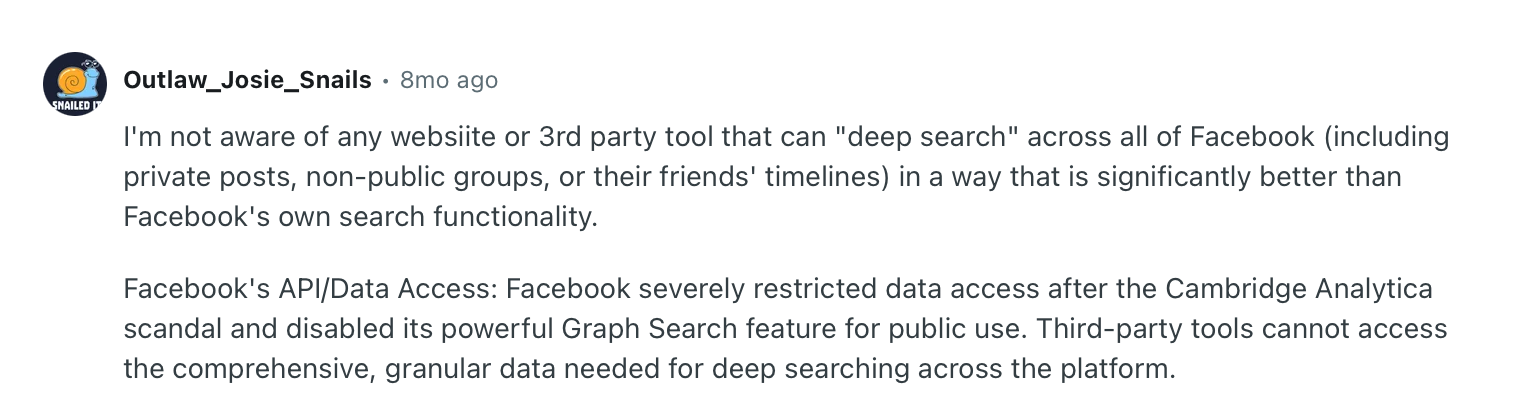
One Reddit user summed up the current state plainly:

This isn’t an isolated complaint; it echoes a pattern seen throughout developer communities: the assumption that a workable search tool still exists somewhere, followed by the discovery that it simply doesn’t, not through any third-party product and not through Facebook’s own interface either.
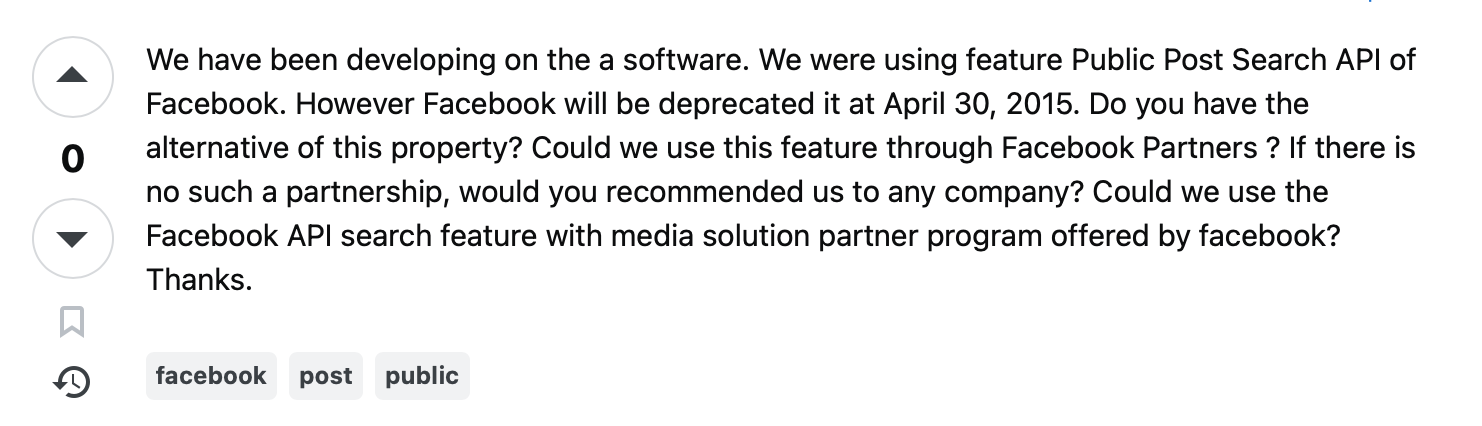
Developers hit the same wall from the technical side. On Stack Overflow, one person asked directly what to do once the Public Post Search API they’d built on was set to disappear:
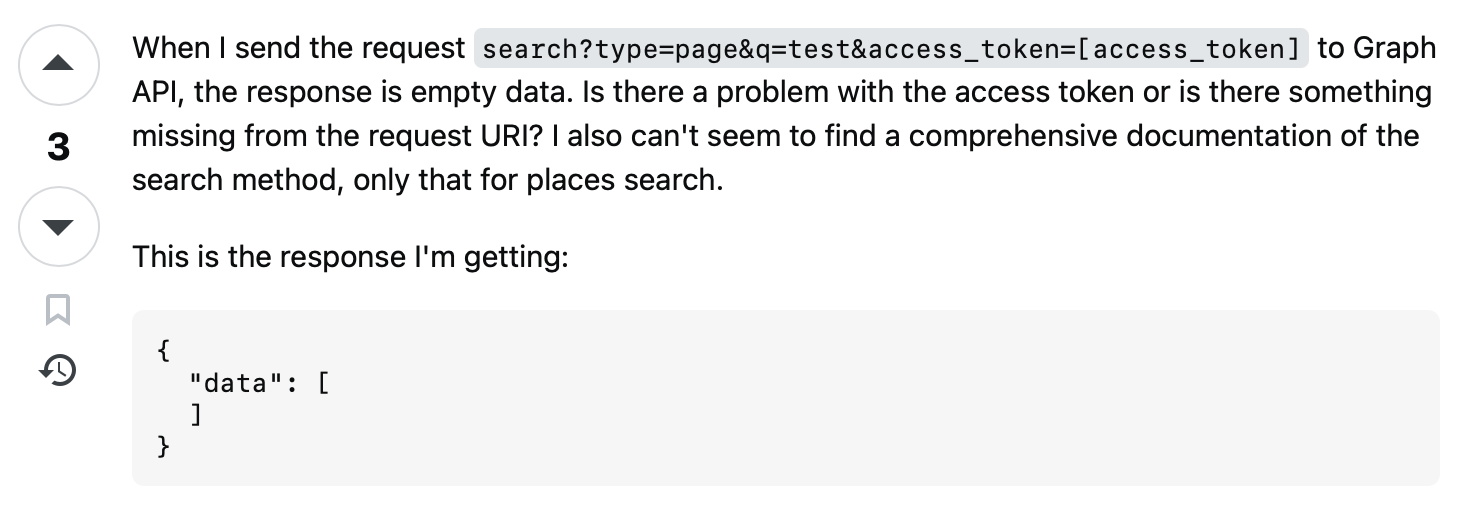
Others ran into the deprecation without warning, still troubleshooting a call that should have worked:
The Responses: Building In-House vs. Going Third-Party
Two camps show up repeatedly once the “it’s gone” realization sets in. Some developers describe building custom solutions in-house to pull the public data they need, working around the API’s narrowed scope through their own tooling.
Others opt for third-party data providers instead, treating vendor access as the more sustainable route rather than maintaining custom infrastructure against a platform that keeps changing its rules out from under them.
Neither camp is presented here as a recommendation but as an honest view of what developers, in their own words, say they’ve actually done once they hit the same wall this article has spent the last several sections mapping out officially.
To Sum Up
Facebook’s approach to search has narrowed steadily over more than a decade — from open keyword search in the platform’s early API days, through the 2015 and 2018 restrictions, to today’s landscape of scoped, permission-gated tools.
What’s left officially works well within specific lanes: Page-Events-Places retrieval and management, Ad Library research for political and EU/UK commercial ads and Meta Content Library access for researchers only. What falls outside those lanes (broad keyword search over posts, cross-network audience discovery, global commercial ad data) now takes combining those official sources with publicly available data from elsewhere on the web to approximate the picture keyword search used to provide in one place.
Getting that combination right takes more planning than a single API call once did — but the underlying goal, understanding what’s being said publicly about your brand, industry, and competitors, is still very much reachable.
Extrahieren Sie Daten aus vier sozialen Netzwerken mit der Data365-API
Fordern Sie eine kostenlose 14-Tage-Testversion an und erhalten Sie mehr als 20 Datentypen


.jpeg)


.jpg)


.svg)
.svg)
.svg)


.svg)
.svg)
.svg)
